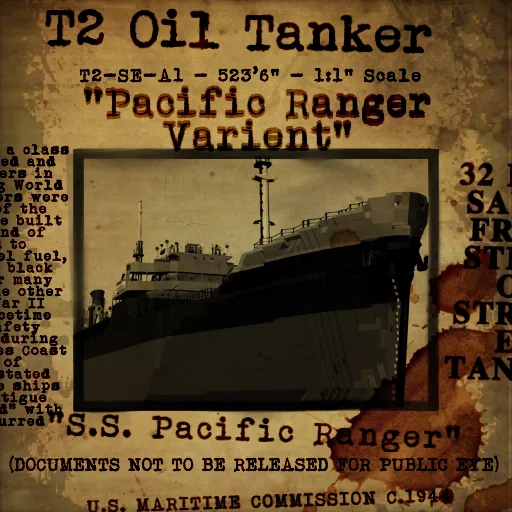
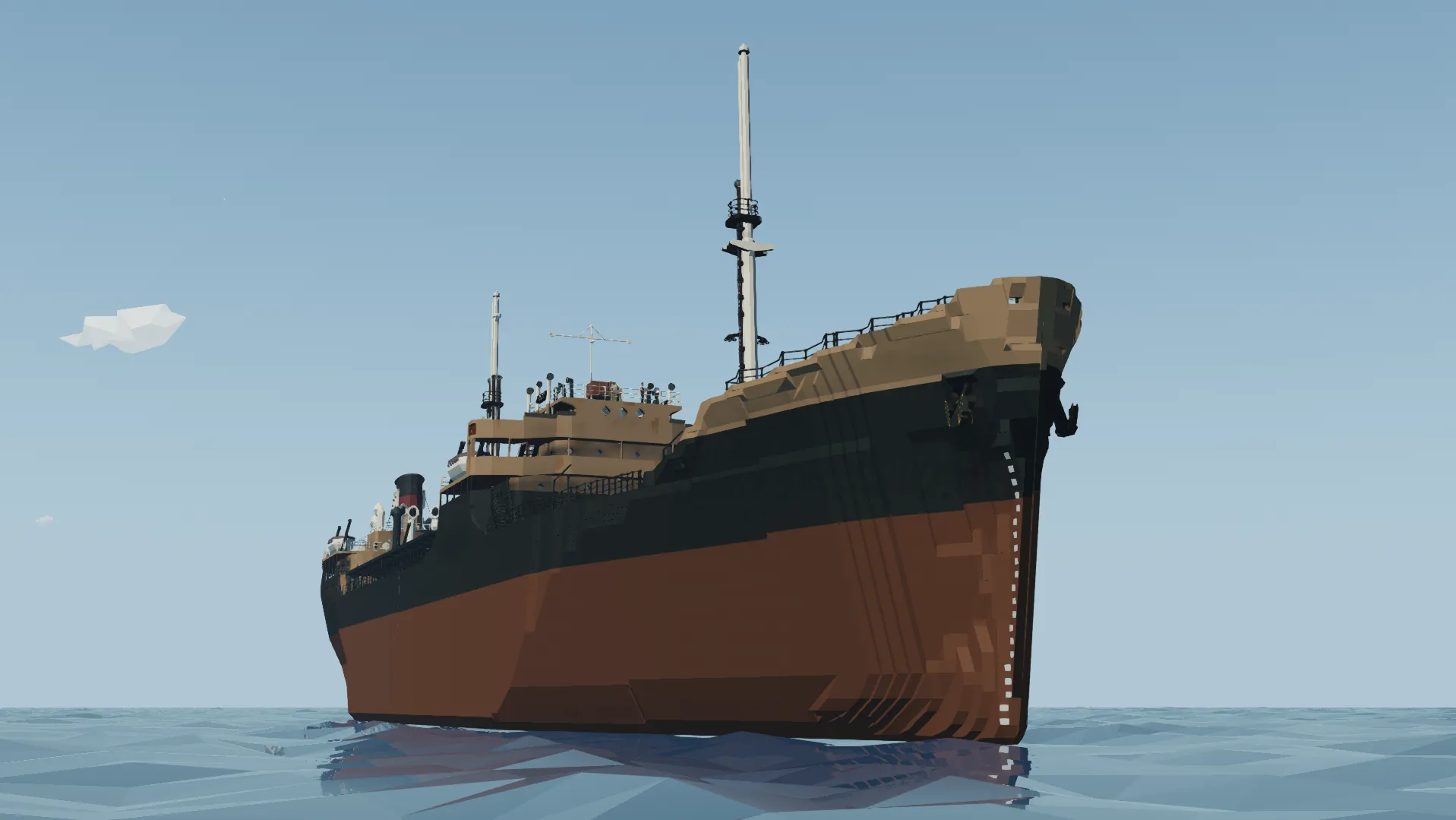
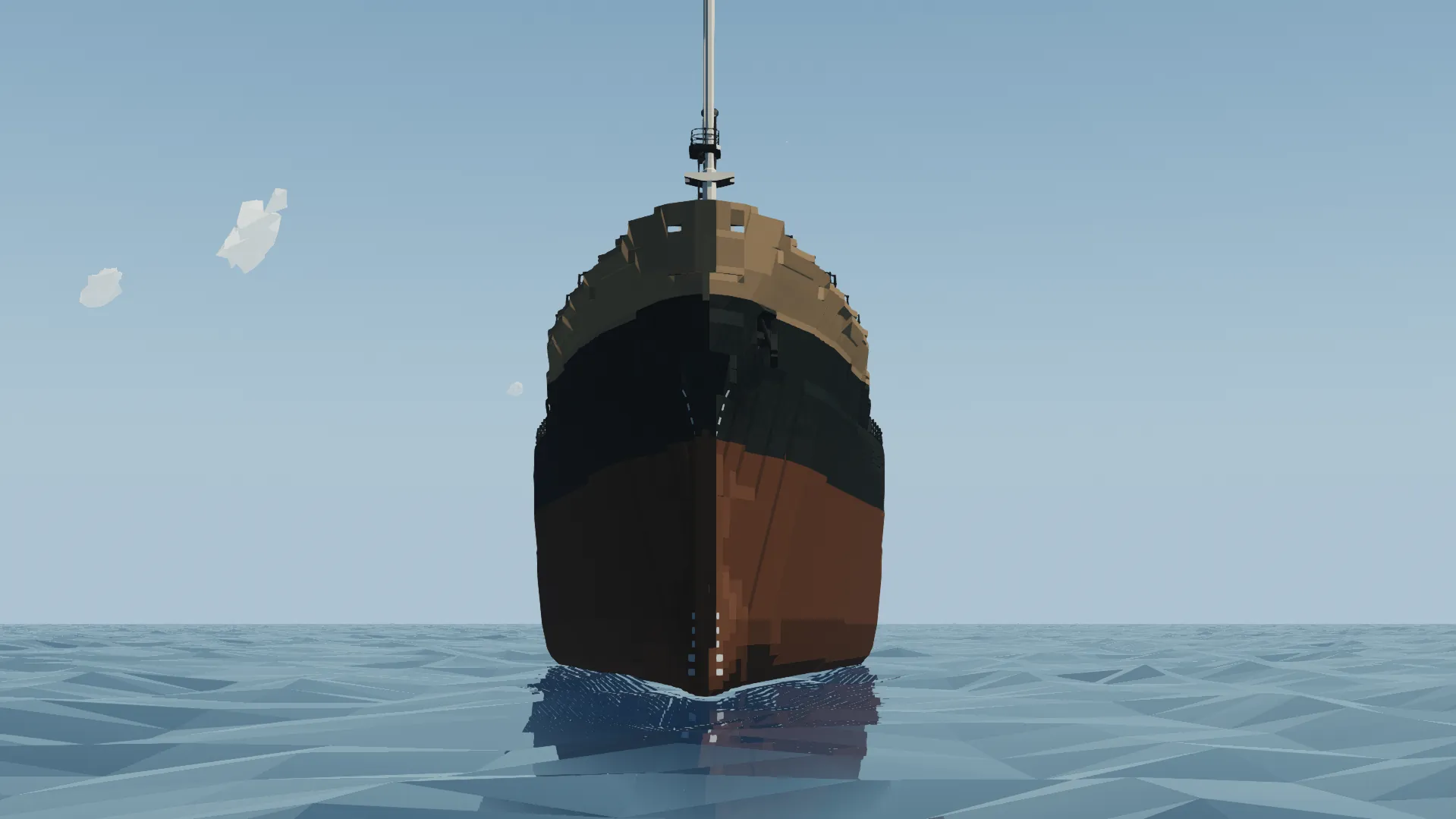
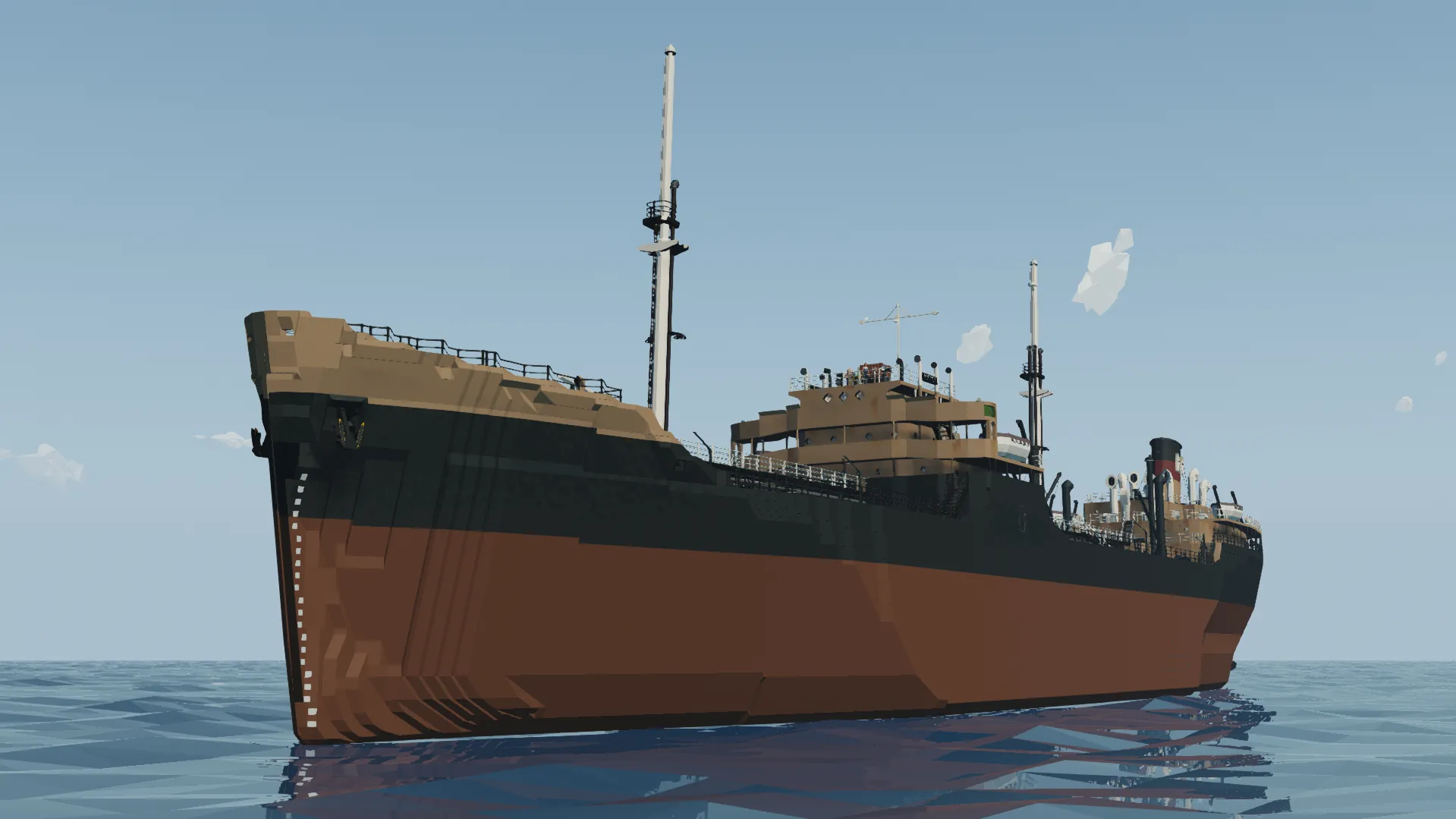
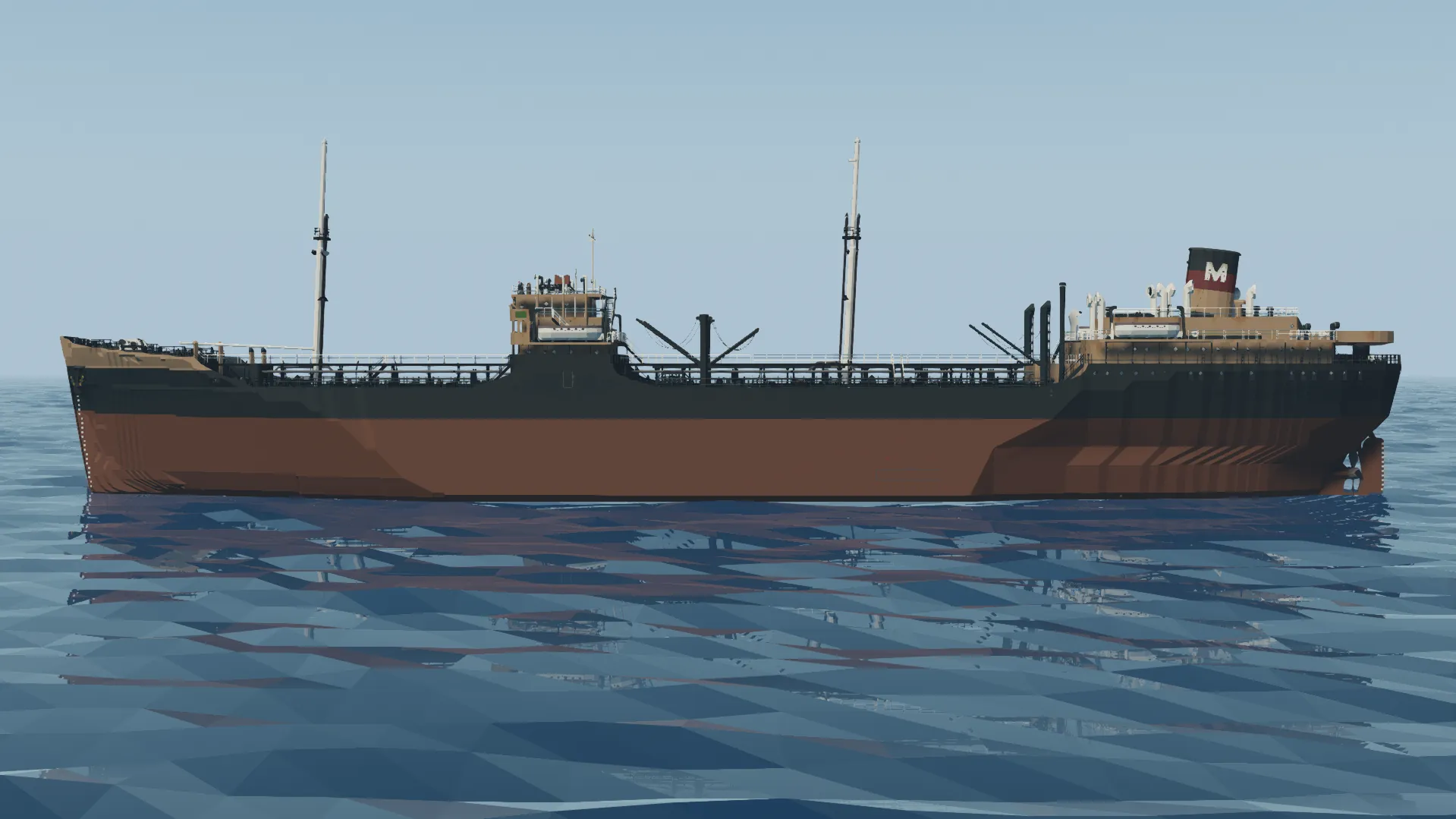
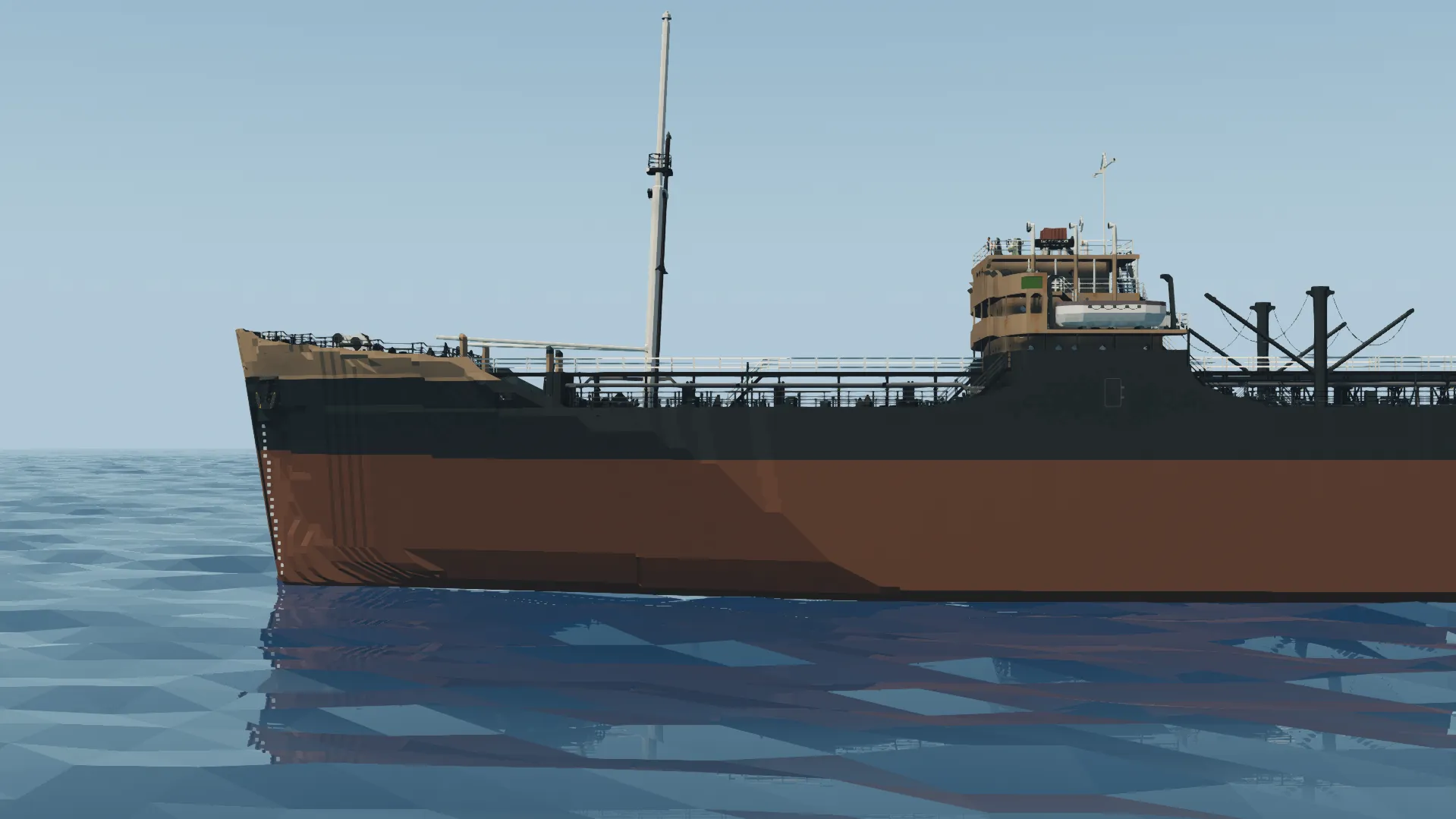
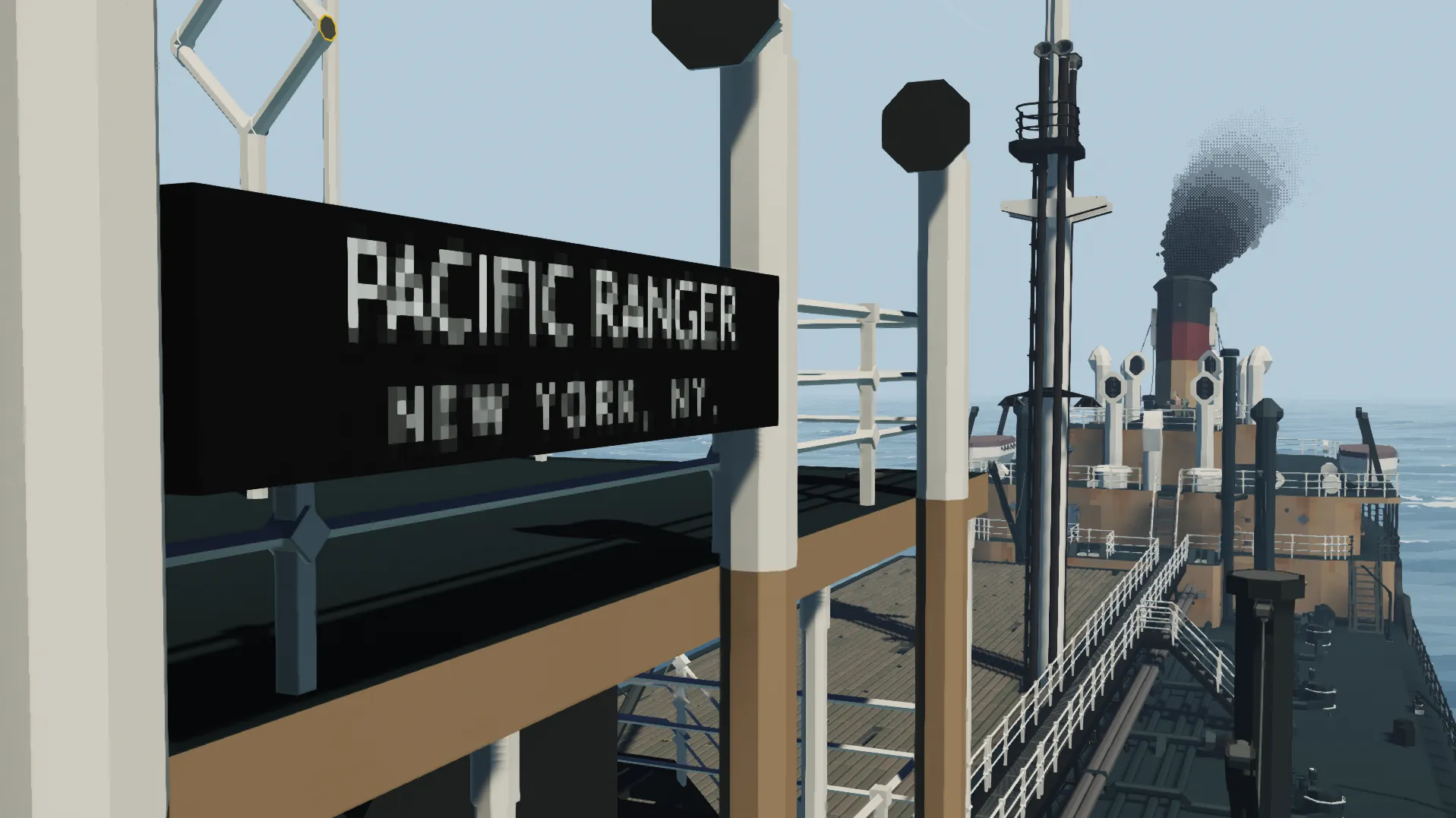
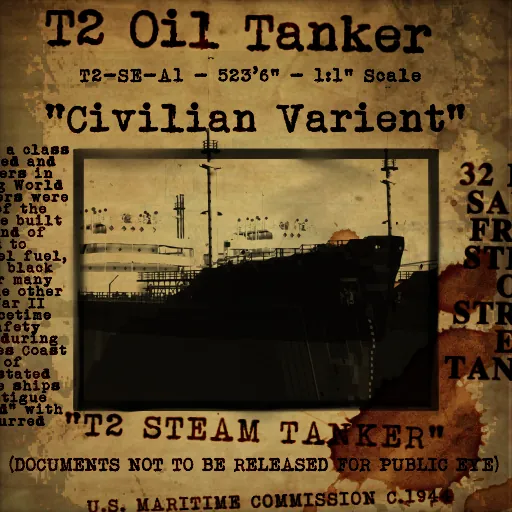
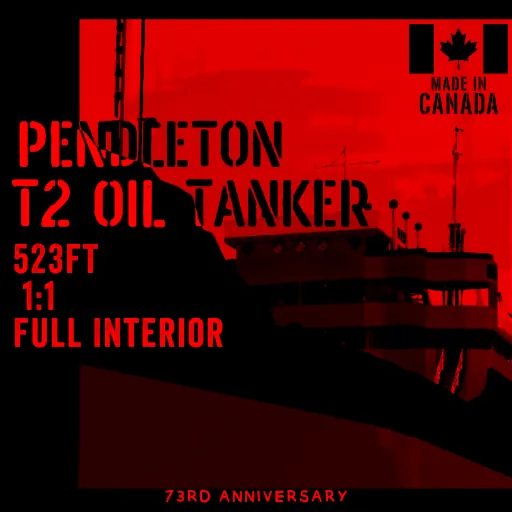
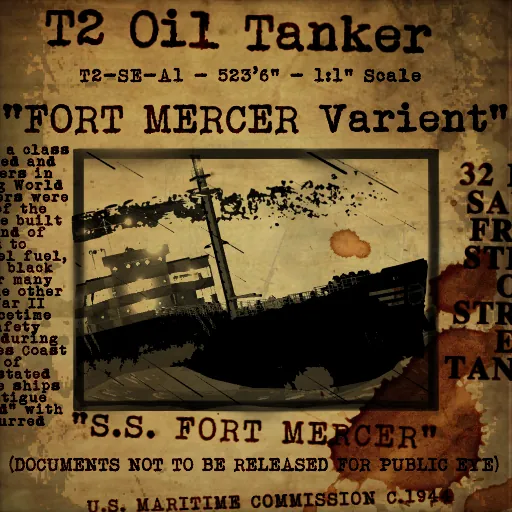
*FICTIONAL* T2-SE-A1 Tanker Pacific Ranger - 1:1 Scale - 523ft long - Near full interior!
Pacific Ranger; A History
Tanker S.S. Pacific Ranger (then the S.S. Delaware), a standard T2-SE-A1 tanker was constructed under the U.S. Maritime Commission’s Emergency Shipbuilding Program during World War II. Her keel was laid on March 1st, 1944, as hull number 465 at Sun Shipbuilding & Drydock Company of Chester, Pennsylvania. She launched on April 26, 1944. The ship was sponsored by Martha Wilson, a representative of the Delaware Tribal Council.
Following sea trials, she was delivered to Standard Oil of New Jersey under a War Shipping Administration (WSA) charter, assigned to fuel transport duties supporting Allied forces in both the Atlantic and Pacific theaters.
From June–August 1944, she participated in Convoy HX-301, carrying aviation fuel from New York to Liverpool in support of post-D-Day operations in Europe. In October 1944, she sailed in Convoy CU-47, delivering fuel to Scotland and Antwerp, Belgium, supporting the Allies during the Battle of the Bulge. (After this, she was transferred to the Pacific in March 1945, stationed at Pearl Harbor.)
Around April 1945, she supplied fuel to TF-58 (Fast Carrier Task Force) during the Battle of Okinawa. A few weeks later, while refueling destroyers, a Japanese kamikaze aircraft (Mitsubishi A6M Zero) attempted a suicide dive toward Delaware but was shot down by escorting destroyers before impact. Later in August 1945, she was moored at Ulithi Atoll, fueling U.S. ships preparing for the planned invasion of Japan (which was ultimately canceled due to Japan’s surrender).
While returning from a transatlantic convoy (CU-50) to the United States, Delaware encountered a severe storm off Newfoundland and sustained mild structural damage. A 4-foot crack formed in her lower engine room, requiring temporary repairs.
After the war ended in 1945, S.S. Delaware was decommissioned from military service and sold in March 1946 to Matessetta Merchantile Marine Co, New York branch. She was retired and underwent extensive repairs at Todd Shipyards, Seattle, addressing wartime wear and hull stress fractures. She was renamed S.S. Pacific Ranger on July 6th, 1946. She generally sailed the west Coast, Alaska, California to the U.S. Gulf Coast crude oil runs, and occasional voyages to Hawaii and Yokohama, Japan.
By late 1948, concerns over hull fatigue arose after the now-welded 4-inch crack in her engine room grew and reopened into a 7-inch hull crack. Repairs were made, but the long-term integrity of the vessel remained in question, though the issue was bottled down.
On November 4, 1949, Pacific Ranger departed San Francisco for Yokohama, Japan, carrying refined fuel oil with a full crew of 45 under the command of Captain Oskar J. Thrustrum. On November 10th, she reported heavy waves as she entered a cyclone, with the closest major landmass being Papua New Guinea (2,761 miles away) and Hawaii (1,482 miles away). Her last reported seas: 67–75 feet. By November 12th, the Pacific Ranger failed to check in with nearby radio stations.
On November 14th, she was declared overdue, and by November 16th, she was officially listed as missing. A search effort was launched, but no trace of the ship was found. On November 25th at approximately 7:34 A.M., search efforts were called off, and she was declared "Lost At Sea". Only a charred, capsized lifeboat, Her Nameboard, 14 Oil Barrels, 2 liferings, one with cloth (probably from a sailor's shirt) tied to it. - A wallet, that had also been tied to the lifering, who belonged to 22-year-old Lloyd J. Sanderson of Bayonne, New Jersey.
LIST OF THOSE LOST;
Oskar J. Thurstrum, Captain
Armen K. Black, 1st Officer
Oliver Zezpraski, 2nd Officer
Angus C. Pratt, 3rd Officer
Nathaniel "Paddy" Powers, Boatswain
Felix D. Hoofer, Carpenter
Victor Mendez, A.B.
Clarence Chisholm, A.B.
Josiah Thorsen, A.B.
Raymond O. Calloway, A.B.
James T. Riggs, A.B.
Leon A. Halvorsen, A.B.
James C. Roswell, Chief Engineer
Malcolm J. Brodie, 1st Asst. Engineer
Douglas Callister, 2nd Asst. Engineer
Hugh P. Salvatore 3rd Asst. Engineer
Gerald K. McKinnon, Firemen
Wesley Hardgrove, Fireman
Terrence R. Olmstead, Oiler
Lionel Z. Donahue, Oiler
Charles Fenwick, Oiler
Archie V. Lathrop, Wiper
Peter B. Kowalski, Machinist
Ruldolph Quincy, Radioman
Percy Wallace, Chief Steward
Francis "Jiggs" D. Mortimer, Cook
Samuel Delacroix, Messman
Vernon C. Hopper, Steward
Hector R. Beaumont, Chief Pumpman
Julius Faulkner, Pumpman
Wallace D. Eklund, Pumpman
Lawrence T. Brigham, Pumpman
Lloyd J. Sanderson, Pumpman
Dennis C. Rowland, Deckhand
Graham W. Kessler, Deckhand
Roger Eberhardt, Deckhand
Stanley T. Winslow, Deckhand
Fred O. Vaughn, Deckhand
Alistair H. Kinnear, Deckhand
Martin Laramie, Deckhand
(For a fun time, speak like one of these crewmembers in the comments!)

What can you expect from this Model?
1. A detailed, meticulously researched model, with details i found out that even surprised me
2. A near-full, accurate as possible interior, full engine room, steering gear, and even spaces that haven't had photos!
3. Roleplay-ability - One example, If your water reaches the generator room intake, then your entire power will go out. Or if the ship breaks in half, bow will lose power, flicker off, and sink.
4. A very explosive and destructive sinking if the waves get high-enough. go and and out for yourself. ;)
5. And so, so much more!
Sidenotes
How to start:
1. Turn on the Diesel Generator located in the generator room corner.
2. turn on all the breakers for the machinery on the Main Switchboard.
3. Go into the boiler room, and start her up.
4. Go back to the Main Switchboard, and Throttle "Steam Flow Control Lever" up, and then "Speed Lever"
5. Turn off Diesel generator.
----------------------
Please favorite and rate!