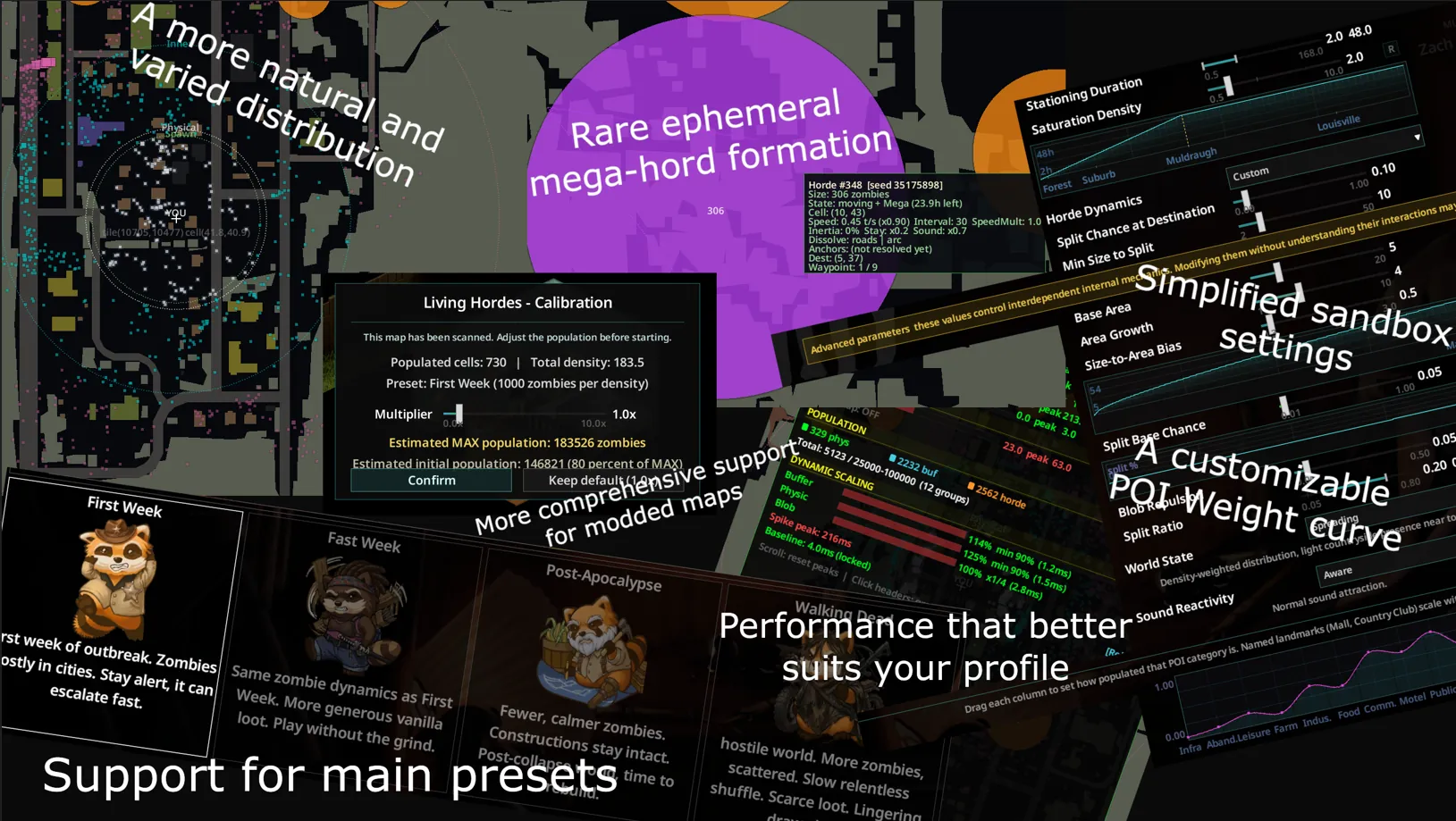
Hi ! This mod is in beta testing, so if you install it, consider yourself a beta tester. Keep in mind that it's unstable and not a finished product (in the sense that a new update is released every week). You are an integral part of the development, so please don't hesitate to discuss the mod's positive and negative aspects with me.
If you enjoy, leave a comment or like for more visibility ;)
For any question, bug report or feedback, please use the discussion thread.
Compatibility check : https://steamcommunity.com/workshop/filedetails/discussion/3691686404/800091475572692219/
Performance Issue : https://steamcommunity.com/workshop/filedetails/discussion/3691686404/800091928768161668/
To follow the progress : : https://discord.gg/GqeDq92qdX [ https://discord.com/channels/908422782554107904/1485669657573589112 ]
Living Hordes - The Walking Dead
Living Hordes entirely replaces Project Zomboid's spawn and migration system.
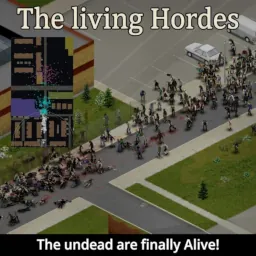
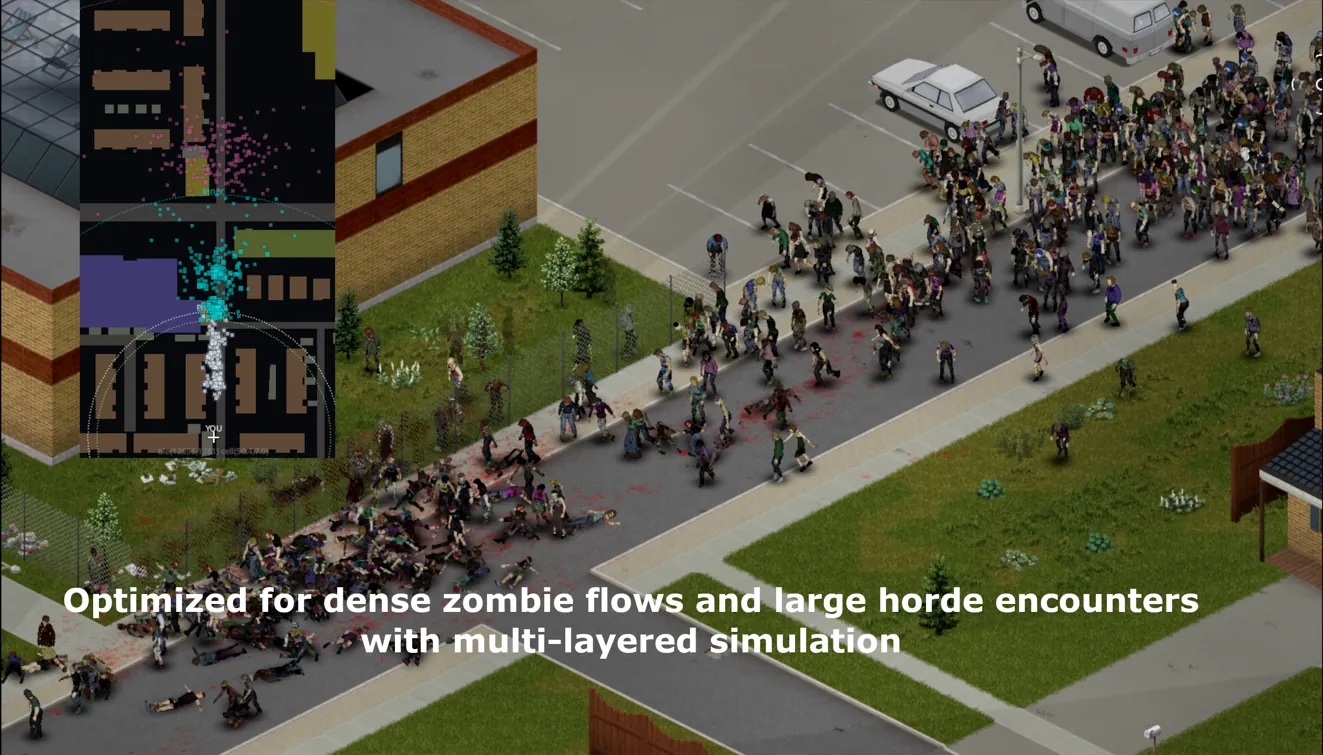
Vanilla spawning is completely disabled. Instead, tens of thousands of zombies are spread across the entire map as migrating groups. They move between towns, roam through rural areas, react to sound and cluster in dense urban zones. If you are in Rosewood, the zombies of Louisville are still there, still moving.
Kill every zombie in an area and it is truly empty. But new hordes will eventually walk in from outside. Safety is earned, not permanent.
How it works
Three-layer simulation
The mod simulates the entire map through three layers of detail, allowing it to handle tens of thousands of zombies without killing performance.
Layer 1: Groups (the entire map)
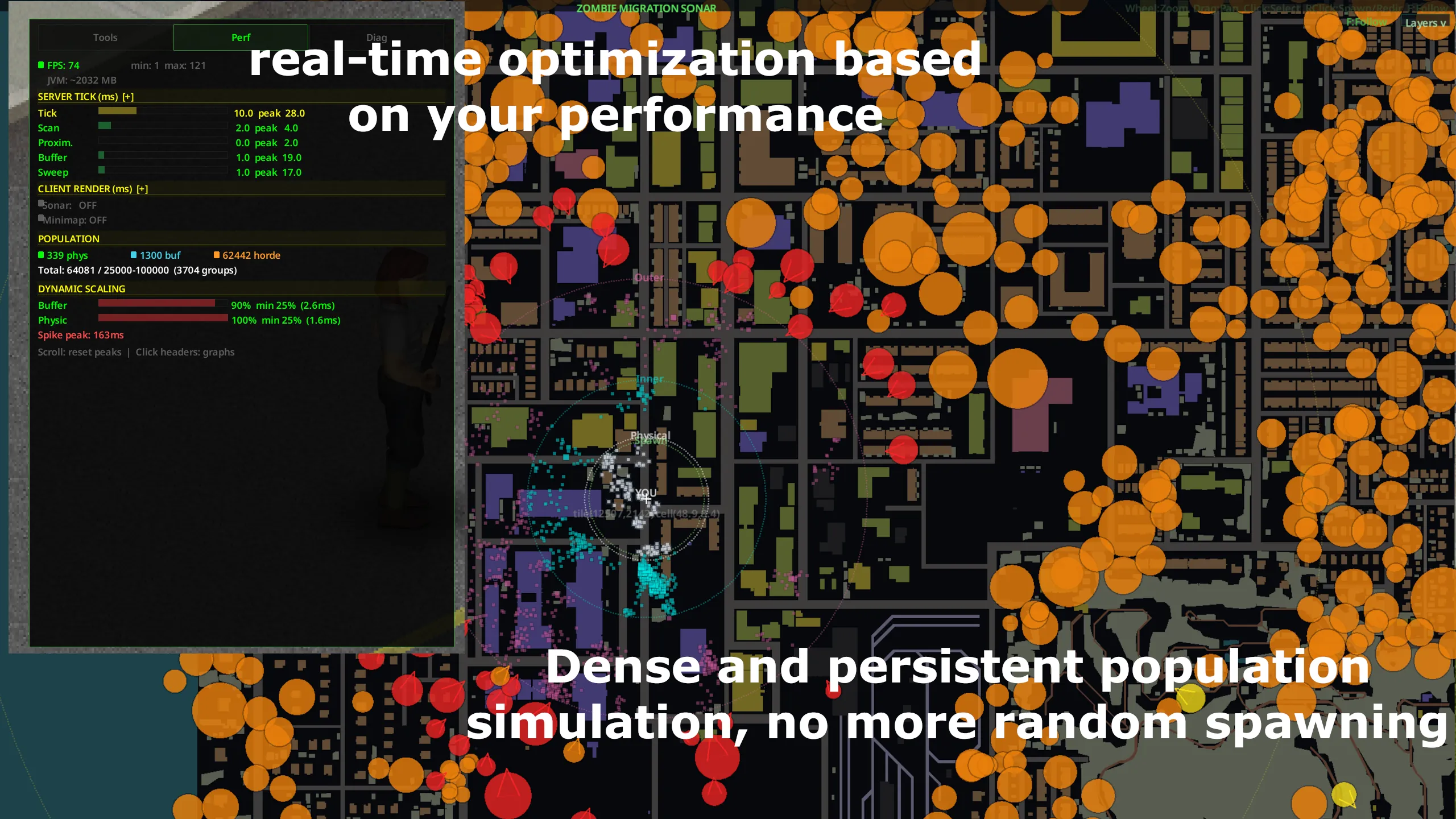
The whole map is filled with groups of 1 to 120 zombies. Each group is a circle whose radius scales with its size, larger groups occupy more map surface. They move, roam, merge, split and station continuously, whether you are nearby or not.
Layer 2: Buffer individuals (around 250 tiles from the player)
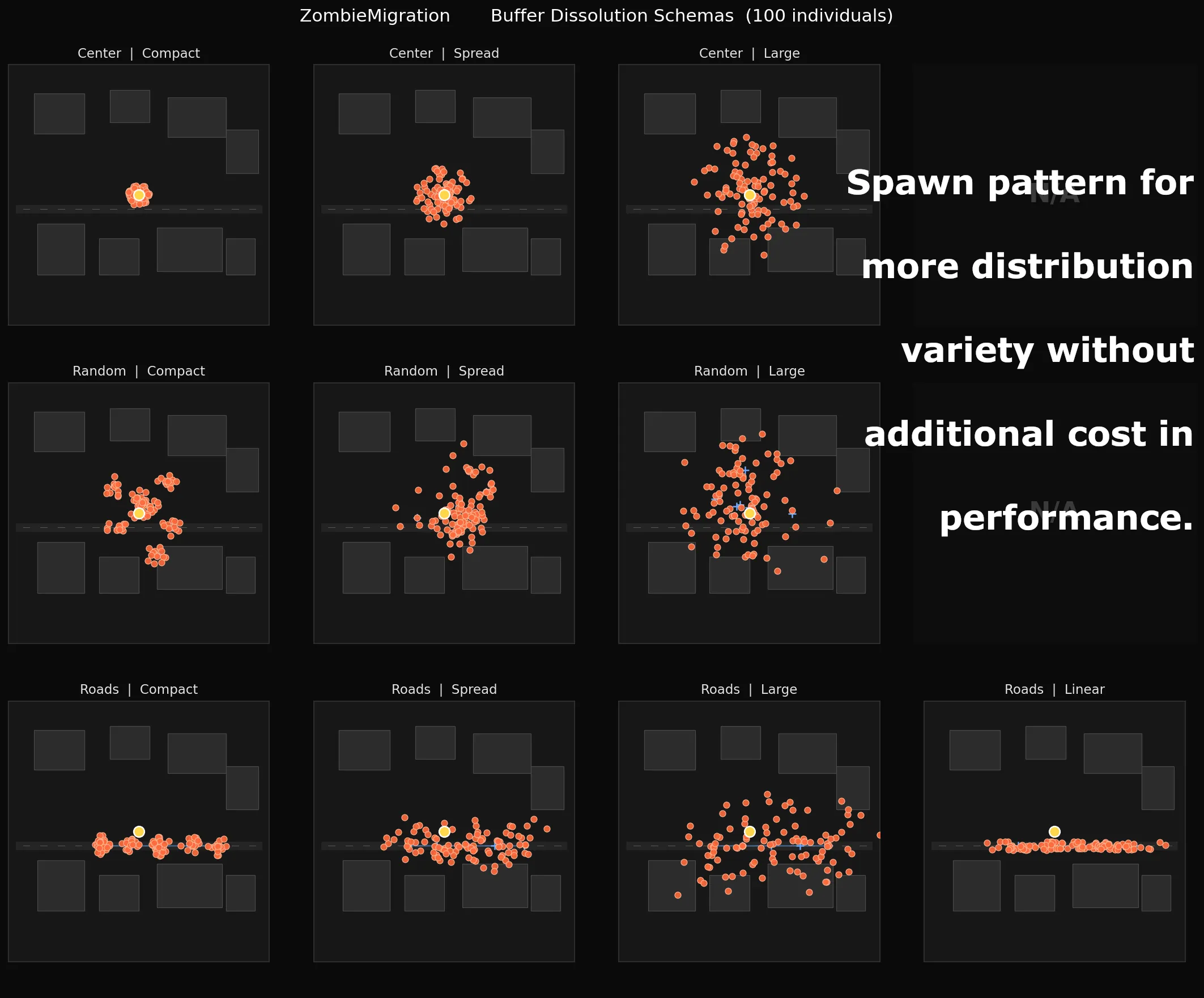
When a group's circle overlaps the buffer zone, zombies are progressively spawned only in the overlapping area. Groups can brush past the player without fully materializing. If individuals walk back out, they reform into groups.
Layer 3: Physical zombies (around 65 tiles from the player)
Buffer individuals entering this zone spawn as real zombies within roughly 10 seconds, all around the group's center rather than only on the side facing you. Leaving zombies are despawned and converted back, preserving their outfit, gender, held weapons (e.g. an embedded knife) and crawler state. A zombie you encountered hours ago in another town will reappear with the same appearance.
Heatmap, calibration and distribution
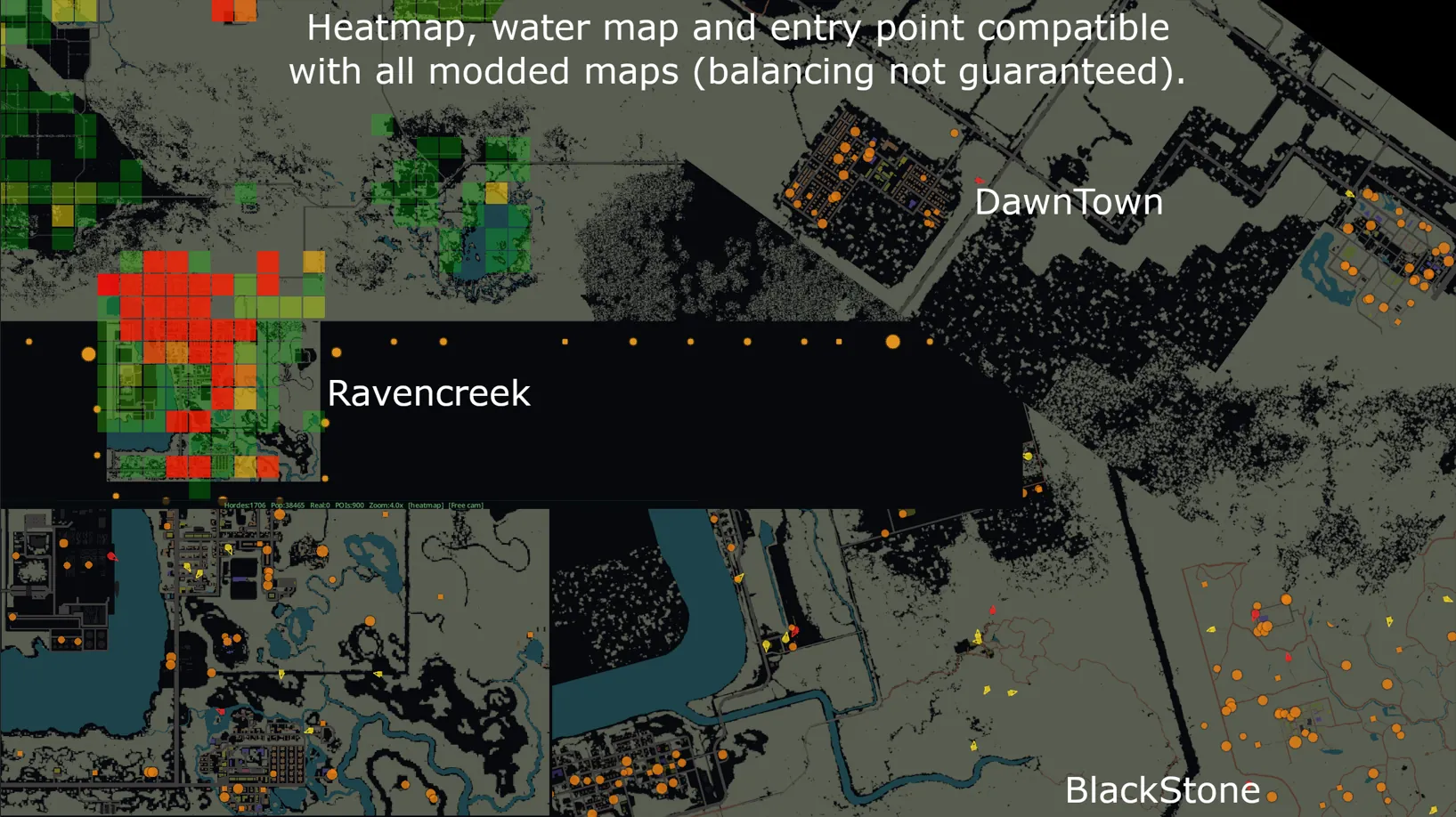
On a new save, the mod scans the entire map and builds a density heatmap weighted by building importance: police stations, hospitals, schools and military buildings carry more weight than regular houses, and horde size scales with building type. Each building has a saturation cap: once full, remaining spawns flow into other buildings in the cell instead of piling up in one place.
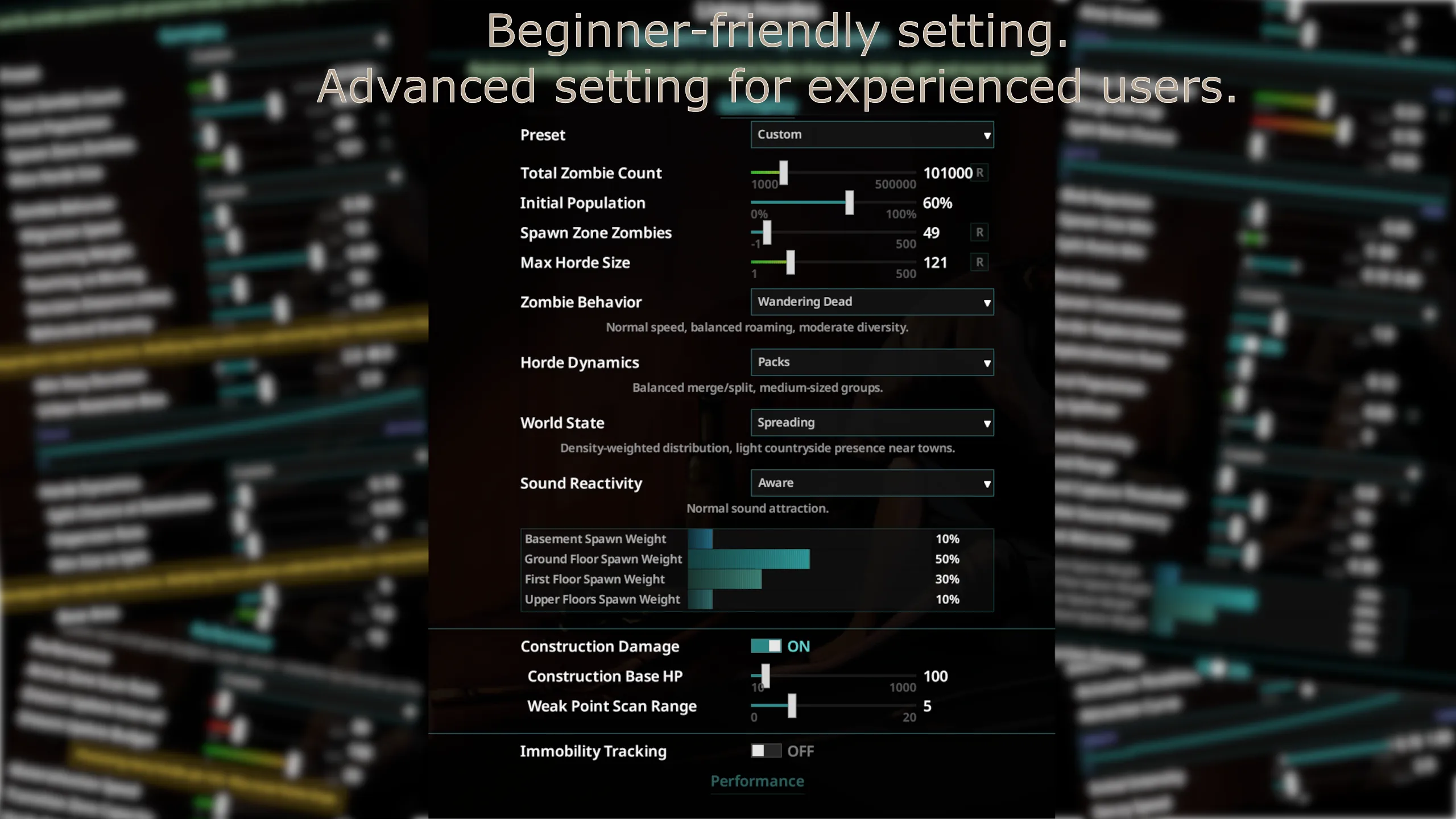
Once the scan finishes, a calibration window lets you review the total density and adjust a multiplier (0.0 to 10.0) with a live preview of the resulting population. You can also tune all POI category weights directly through a curve editor in sandbox.
Rural areas feel emptier, urban centers feel denser. Modded maps are scaled automatically from their actual points of interest.
Migration, personality and interactions
Groups move independently of the player. Each group has a unique seed defining its personality: speed, stationing duration, sound sensitivity, roaming tendency, cohesion. No two groups behave the same.
They pick destinations among points of interest, generate noise-shaped waypoints and travel at their own pace. Movement is interpolated and smooth, no grid-walking or teleportation. Most start by roaming aimlessly before latching onto a destination.
Groups are circles that interact on contact. When two overlap, zombies transfer progressively from the smaller to the larger. Large groups can split at destinations. In sparse areas they drop stragglers, in dense areas they absorb loners. Cities grow denser over time while rural zones thin out.
Mega Hordes
When a horde doubles its maximum size, it has a chance to enter a rare Mega state: it no longer fragments, no longer stops to rest, and relentlessly marches from one dense area to another. Mega hordes appear in a dedicated color on the sonar. Their duration is limited (24 hours average, 48 hours maximum), after which they organically dissolve.
Sound system
The mod captures world sounds (gunshots, alarms, vehicles, screams, the helicopter) and propagates them through all three layers.
Buffer individuals within range pursue the sound source for up to 60 seconds, remembering where they heard it. Groups receive a directional bias that pulls their trajectory toward the noise over time. Sensitivity varies per group based on personality.
Player Base Protection
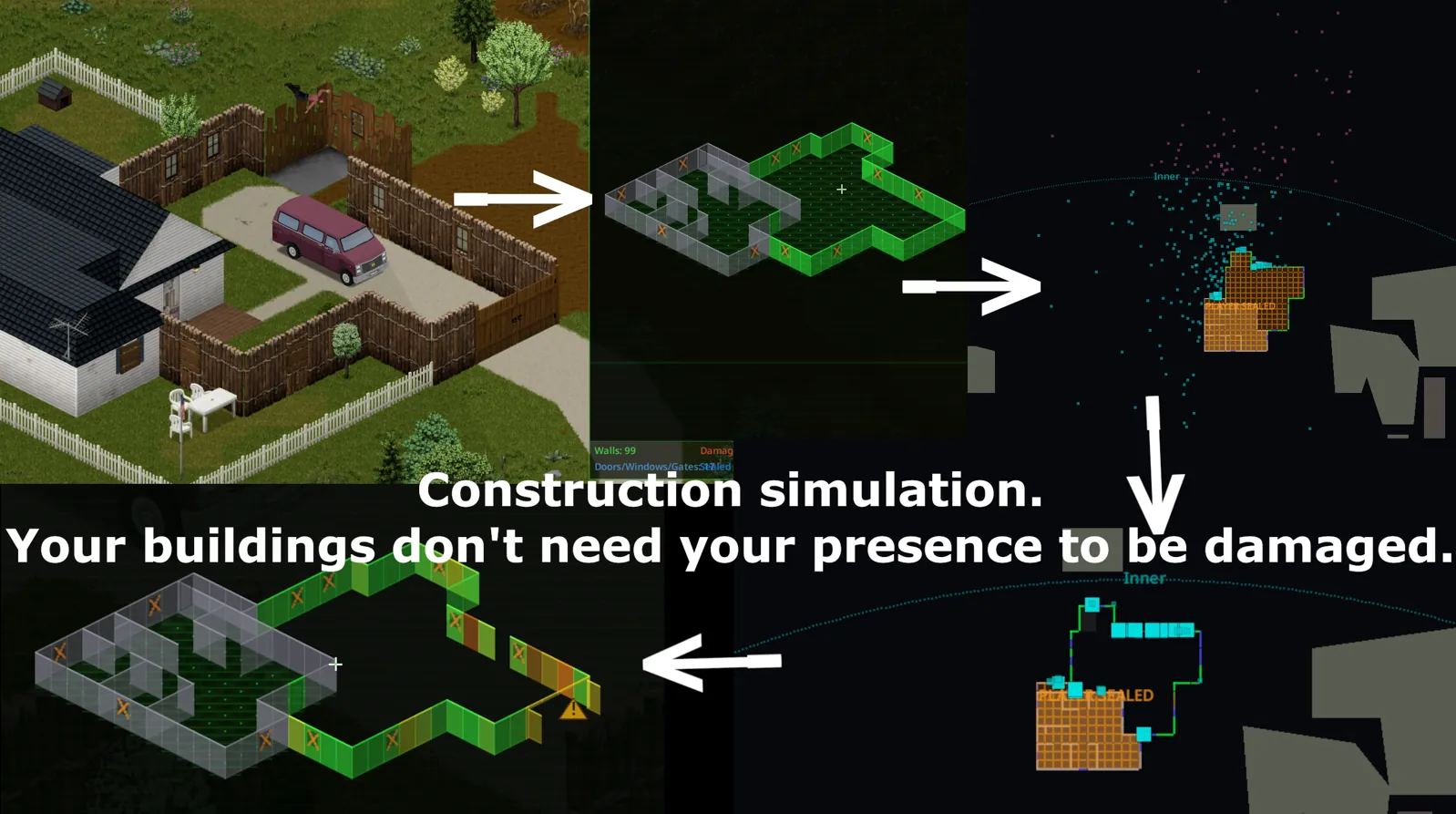
Player constructions are detected and integrated into the obstacle system. Each constructed tile has durability based on its actual in-game health. Buffer zombies applying pressure against a wall gradually deplete its health. Individual zombies have little chance of breaching, but a horde can break through over several in-game hours depending on your materials and skills.
Each room is tracked independently. A room stays sealed as long as no chain of open doors or broken walls connects it to the outside. Lock your bedroom and it stays safe even if the front door is wide open. Vanilla buildings use the same per-room model once you visit them.
A dedicated Base Security Interface (accessible from the in-game side menu) lets you visualize breaches, open entries and construction health at a glance. All breach settings are adjustable in sandbox.
Vanilla game modes
The four vanilla game modes automatically apply the matching Living Hordes preset when picked on the New Game screen:
- Apocalypse becomes First Week: balanced reference, medium hordes, normal sound reactivity.
- Outbreak becomes Fast Week: same zombie dynamics as First Week, vanilla side gives more generous loot.
- Rising becomes Post-Apocalypse: fewer, calmer zombies, no construction damage.
- Extinction becomes Walking Dead: slightly more zombies scattered into countryside, slow relentless shuffle, light immobility tracking.
Custom Sandbox is untouched for players who want full control.
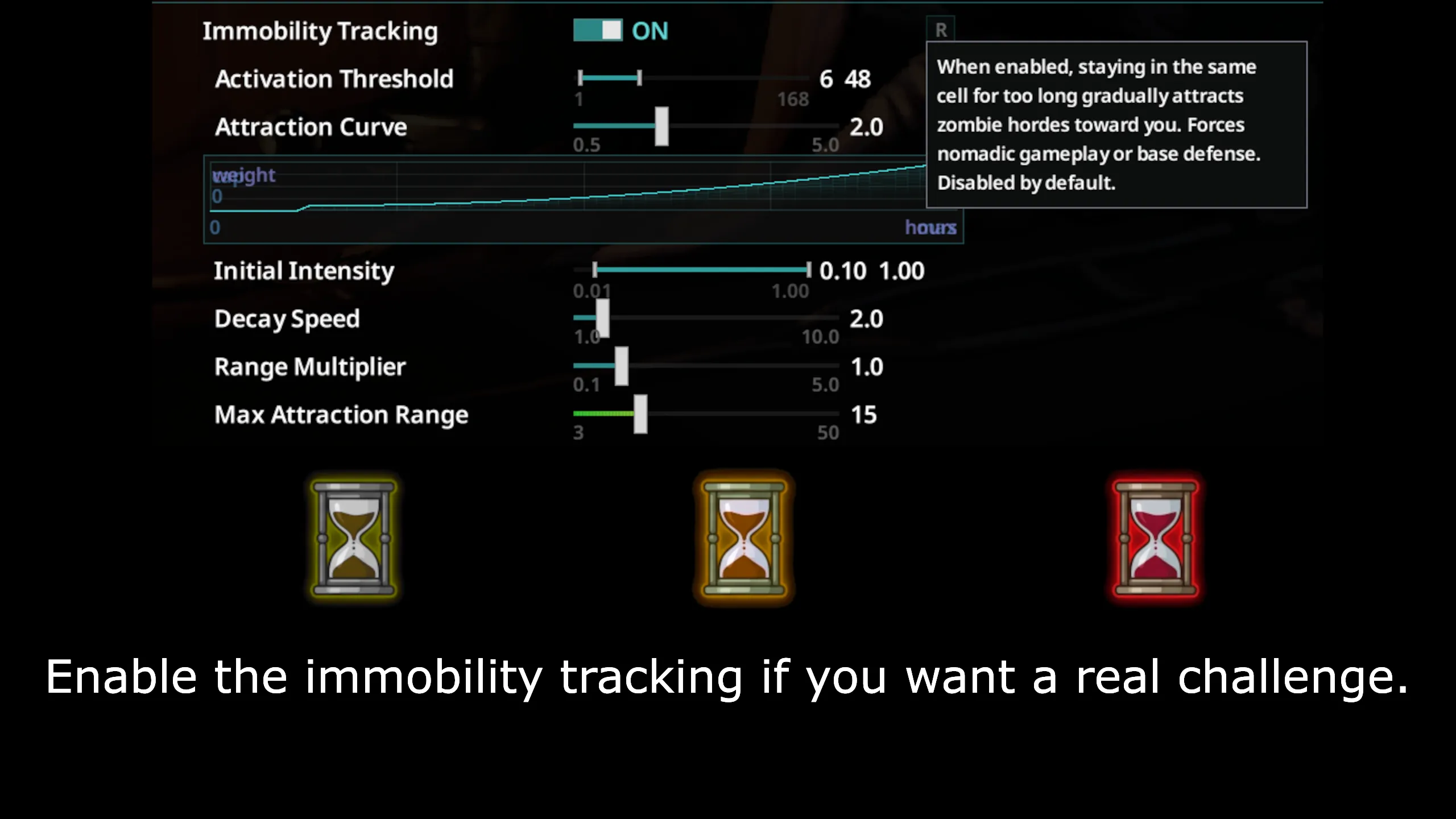
Immobility Tracking
Optional sandbox feature (disabled by default). If the player stays in the same area for an extended period, their attraction weight gradually increases, drawing more groups toward their position. Moodle indicators at 25%, 50% and 75% warn you when groups are closing in. Fully configurable.
Performance
A single Zombie Density slider (0-100%, default 25%) controls how many zombies the mod tries to keep alive around you. Combined with the adaptive performance scaler, the actual cap can also temporarily exceed your setting when the machine allows it.
The scaler isolates Living Hordes' own cost and only reacts to that, ignoring FPS drops caused by Java garbage collection, other mods or chunk loading. It learns your machine's baseline during the first minute of play, then keeps refining it during calm periods. Thresholds adapt to your hardware instead of using fixed values.
A debug overlay shows the scaler state (learning, locked, refining), and a Rebase button lets you restart the learning phase manually if you change hardware or mod setup. Settings can be adjusted mid-game from the options menu.
AI Disclosure
Developed with AI assistance for code. Design, architecture and decisions are my own. AI-only comments are removed.