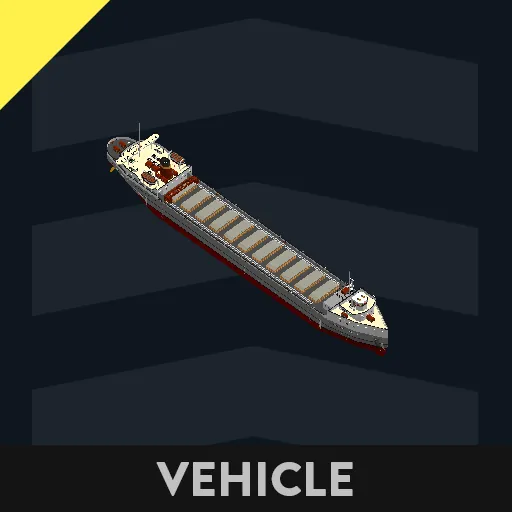
RADAR by Mr NJersey
Spawn:
Go to the mission editor
Select a location
Go to add vehicles
Select ship
Start up:
Head to engine room and light boilers
Head to either pilot house or docking bridge and engage throttle (You guys asked me to simplify it from last time)
Background:
In the early 1920s the Arctic Shipping Corperation (first established in 1851) was expirencing the unprecedented boom in the wake of the Great northern war between the Arctic Federation and the Sawyers Republic. The company up until this point had only ever fielded smaller bulk carriers and package freighters but now it sat at a crossroads, they could continue down the already established fleet arrangement or they could try something unprecedented. New ship building techniques and advances in metallurgy now meant it was possible to build truely massive cargo vessels. In a historic vote 7 to 2 the company under its new chief executive Edsall Carter Andersdale would set out to build a giant that would encompass both the marvels of industry and the dangers of being the first.
Design:
The ship laid down in 1925 at the Great Southern Shipping Companie's Olsen Bay shipyard had a length of 102m a beam of 12.75m and a draught of 4.5m. The ship would displace 4000 tons empty and was rated to carry upwards of 14,000 tons of iron ore. She was powered by 2 Hitchcocks water tube boilers that provided steam for 8 Marlin Marine geared steam turbines and turned 1 3.5m fixed pitch propeller, this gave the ship a maximum speed of 15 knots. She would have 4 large cargo holds each accessed by 3 hatches. Her crew would consist of 28 men with acomidations for 2 passangers (mainly for the occational company higher up). As she was to be the company flagship no exspence was spared with her crew accomidations be better that some ocean liners at the time. Throughout her construction the hull remained unnamed with suggestions such as Trade Winds, Northland, and Odin being thrown around but eventually the board of directors decided that the first ship of the companies new era should be named after the man who made it all possible, she would be named the E. C. Andersdale.
Service:
The ship was launched on May 3rd 1938 and after fitting out entered service on the 2nd of Febuary 1929 imediatly becoming the company flagship. In her first year she set 3 records for the amount of iron ore carried in a single trip. Through out the 1930s the ship would prove to be a huge comercial success exeeding all expectations that by 1934 the company had ordered 4 aditional hulls to a modified design these would become the Magnus, G. Stewart, Leo Ferdinad and Danial Moon. The Anderdale through most of the ships life there would be few incidents of note outside of the odd ground strike coming in and out of Olsen bay but since coast guard regulations at the time only required the reporting of major incidents these slipped inder the radar. The ship had a quite service life during the 1940s even as the world decend into war the freighter would continue on in a reduced role servicing between port Articus and Mount Paradice.
In the early 1950s the ship would be pulled from active service in anticipation of her recieving a major overhaul to increase carrying capacity as well as in preperation for the ship being moved from the frozen waters of the arctic to the sub tropical waters around the Sawyers islands and Mieir. But for almost a decade nothing would be done as the ship rotted away in Port Articus.
In 1959 a fire on board S.S. Magnus left the ship a burnt out wreck and in response the company would finally forck out the cash to bring Anderdale back online. The ship was dry docked for thriteen months, in that time she would recieve a large deck davit crane for moving the new 1.5 ton steel cargo hold hatches now required by the Sawyers Repulic, her number 1 hatch would be removed and replace with a small machinery hut with hydraulic motors to power the new deck crane and a new surface search radar set. Also during this refit the coast guard would grant permission for the ships load lines to be increased allowing her to now carry 17,000 tons or ore when fully loaded.
May 1961:
On May 1st 1961 the E. C. Anderdale under the command of captain George Turner left arrived in port Uran on the northern shore of Terrasaur Island and began loading 16,500 tons of iron ore. As the ship was finishing loading at 1pm, captain Turner was aproached by two of the ships deckhands who informed him they were quiting. During the run south to port Uran the chief engineer had the two men collect hundreds of sheared off rivettes from the ships access tunnel and they no longer felt safe on board. The captain was annoyed by this but gave them their final pay check and left to find two more men, he returned after an hour having had no luck and decided he could do without them. The ship departed port at 4:00 pm headed for Olsen bay. Winds were 20 knots from the north west and and swell was around 1.5m but captain Turner wasn't worried, his ship had seen worse.
At 12:00Am that night the ship completed its 12 hourly check in reporting no major issues but did report that there was about 10cm of water in the access tunnel on the port side of the cargo holds.
At 12:40PM on May 2nd coast guard station North Mieir was notified by the Arctic Shipping Co, that the Andersdale had missed it's 12 hourly radio check in. At first it was believed that in the storm the ships radio had simply failed but as the days went past concern grew and when the ship finally missed its schedualed arrival at Olsen Bay on the 4th, a large search involving 21 ships was launched but after 12 days of searching nothing was found.
The following year a marine board of investigation conviened to investigate the sinking and there findings were inconclusive and eventually settled on blaming unsecured cargo hatch covers for the sinking.
And that was the end of the ships story till June 2023 when the servey ship Endurance while serveying a potential submarine pipeline sight detected two large metal contacts 2 km apart in 300 meters of water, ROV's were sent down the following day, initally believing it was two wrecks in close proximity, but as they serveyed the wreck they came across a name plate E. C. Anderdale. Sometime during that storm 61 years earlier captain Turner and his bridge crew would of heard a loud screeching sound as the power went out in the forward part of the ship they would of looked back in horror to see the stern drifting away from the bow. The radio would have been useless as there was no emergancy batteries for the unit. Anyone who made it into survival suits would of made it 15 hours in the water, it took 48 hours for anyone to start looking.