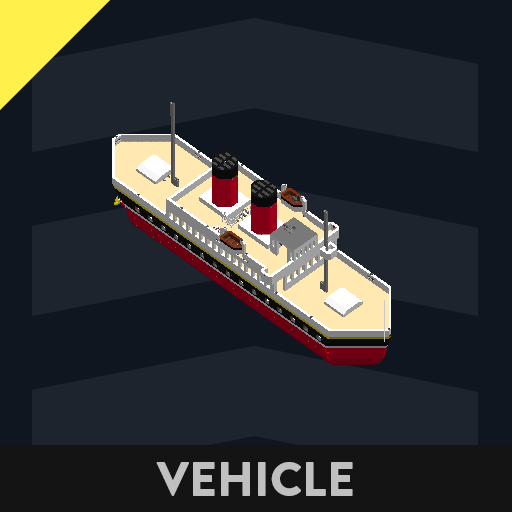
(PLEASE NOTE! THIS SHIP IS VERY SPARTAN AND RUDIMENTARY, AND HANDLES HORRIFICALLY! SUBSCRIBE AT YOUR OWN RISK! INFINITE ENERGY AND FUEL ARE REQUIRED!!)
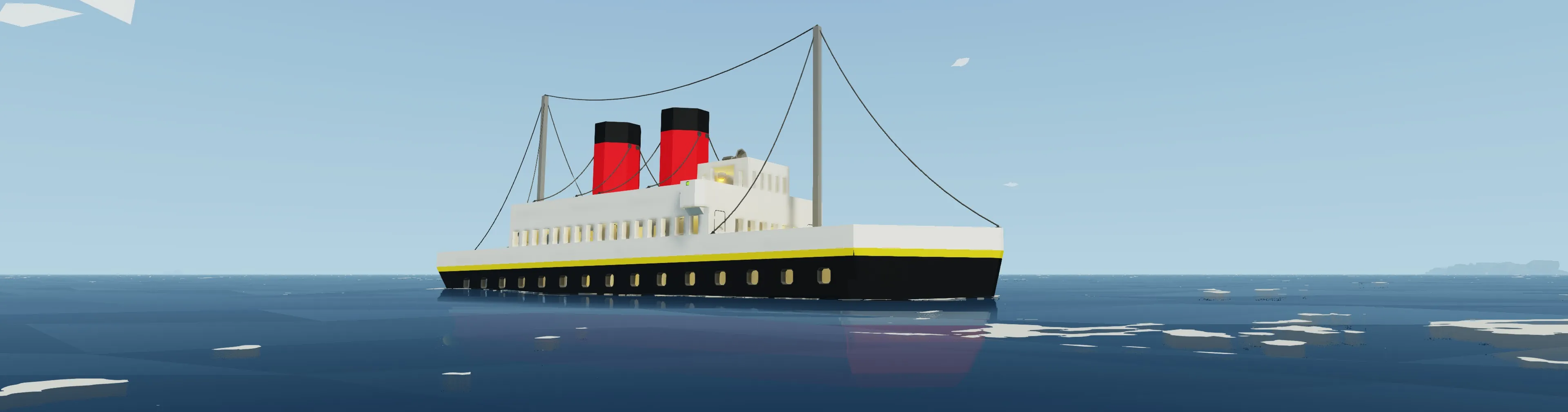
Launched on April 1st, 1913, (a date that, in hindsight, feels less coincidental than prophetic) the SS Ambiguity was the Versailles Steamship company's ill-fated attempt at an affordable transatlantic liner. Designed to be an ocean-going passenger ship, her shockingly compact size, and top-heavy structures made her fundamentally unfit for the task. However engineers insisted for her to be launched and put to sail,
Upon launch, Ambiguity immediately began to list violently, nearly capsizing in front of a horrified crowd. Shipyard workers, panicking, began bailing water with buckets while engineers stuffed her with hastily added ballast to stabilize her. As a result, she sat 10 feet lower in the water than designed, with the stern dipping so low that waves regularly splashed over the railing, resulting in passengers being washed overboard, and the ship having to make routine stops to pump out water. (and retrieve lost belongings)
During sea trials, inspectors described the experience as “life-altering” and “unshakably damp.” Despite nearly capsizing on every turn and trembling like a washing machine full of bricks, she achieved Sufficient speed -just enough to technically qualify for service.
With the outbreak of World War I, the Ambiguity was nervously requisitioned as a hospital ship, as the military feared she might capsize under the weight of marching boots alone. Converted in haste, she performed surprisingly well despite suffering three separate groundings, including one instance where she ran aground while docked and un-moving. Nonetheless, she developed a cult following among medical staff and wounded soldiers, who affectionately dubbed her “The Crooked Angel,” and “The Rattling Lady,”.
Returned to passenger service after the war, Ambiguity retained her quirky charm, with many passengers even taking a liking to it. On December 18, 1921, she limped into port with crew members visibly shaken and claiming they were attacked by "the Kraken." More likely, she threw a propeller blade, which rebounded off the hull and sparked chaos. Oddly, passengers reported enjoying the excitement.
By the mid-1920s, she became popular for dirt-cheap “booze cruises,” though no alcohol was ever served. The erratic motion and swaying of the ship (likened to being inside a washing machine tied to a trampoline) convinced passengers they were drunk regardless.
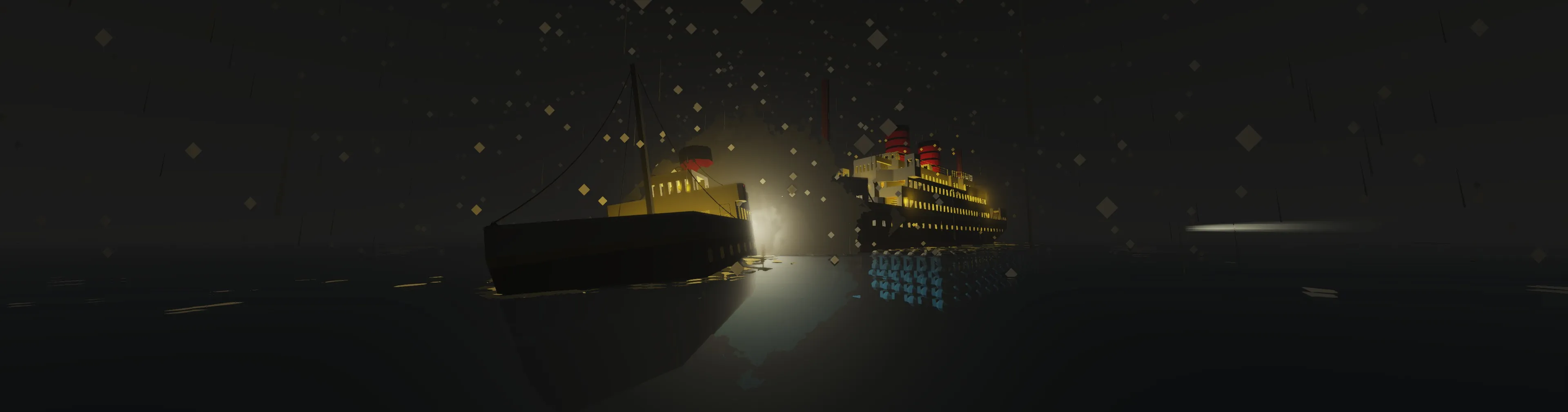
In one of her most infamous moments, Ambiguity was rammed by the massive SS Arctic (which itself was notorious of collisions), while in dense fog. Although Ambiguity was notoriously loud, with clanking engines and screaming pipes, her sounds were completely drowned out by the Arctic’s booming whistle, and thunderous engines.Following the collision, Arctic steamed on at full speed, with her crew completely unaware it even happened. While docking in New York, spectators cried out in horror at the Ambiguity, still lodged into the re-enforced Bow of the Arctic. Miraculously, Ambiguity suffered only cosmetic damage, being described as a dented sardine can, and having no injuries. The Passengers, who were mid-meal at the time, described the ordeal as a “pleasant surprise" and made statements such as "The soup turned 90 degrees, and the ship finally felt like she was going somewhere.” During the ordeal, she gained roughly 5 knots in speed (being dragged by the Arctic) and Despite the 45° lean at impact, most passengers didn’t notice aside for the collision, being used to the ship’s perpetual slant. Upon docking, many passengers even thanked the Arctic's crew. The following lawsuit (held by the Ambiguity's owners) wouldn't be because of the damages, but instead out of spite that the Ambiguity wasn't completely sunk.
Scheduled for scrapping in 1936, a clerical mix-up resulted in the brand-new liner which was under construction, 'Reverence' being dismantled instead. Before anyone could realize the mistake, WWII had begun, and Ambiguity was again requisitioned - this time as a scuttle-training target ship, intended for sailors to practice controlled sinking, or to practice using weapons on. She was, naturally, never successfully sunk - every attempt failed, often due to torpedoes bouncing off her strangely soft hull plating, or flooding simply exiting through the stern drains.
After the war, she had a brief Renaissance, before being bought by the obscure Capybarra Cruising Company, which conducted bizarre renovations, including replacing her two iconic funnels with a single, over sized one, rebuilding her bridge with asbestos-lined wood, and somehow increasing her lean. Through the 60s–80s, she shuffled between roles: a cruise ship with no running water, a floating motel with rooms slanted at up to 12°, and finally, a fast-food restaurant, serving lukewarm fish sticks and mystery chowder. During her hotel years, she became famous not for luxury, but for the long line which extended from the reception desk, all the way down the gangway. This line was not for fanfare however, but instead refunds. One travel magazine called it “the only hotel with a built-in protest queue.” Management tried to spin this into a feature, even hiring a mascot called 'Captain Refund' but it only attracted more lawsuits.
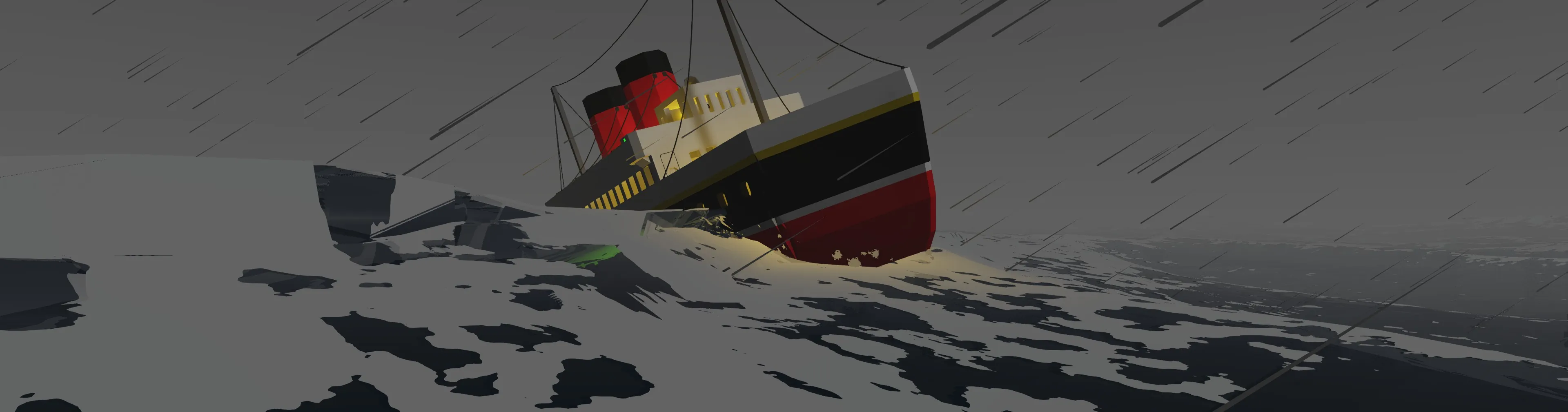
By the early 2000s, a maritime conservancy acquired Ambiguity, promising to restore her to her “original glory” (a term critics called “oxymoronic.”) On her final voyage, safety inspectors were taken aboard for a full condition report. They never finished. Due to catastrophic hull failure, brought on by decades of neglect, Ambiguity began to flood quickly and dramatically, slipping beneath the waves mid-inspection. Ironically, the vessel’s natural tendency to drop like a rock allowed everyone to evacuate safely -being immediately washed overboard, -a final, half-hearted nod to her stubborn refusal to kill anyone outright.
Though her record is riddled with collisions, complaints, leaks, and refunds, Ambiguity somehow earned a place in maritime lore. Historians call her an embarrassment of engineering, a cautionary tale that refused to die, and the ship that existed solely to prove everything can go wrong and still float.
Today, she lives on through black-and-white photos, angry Yelp reviews from the 1980s, and a half-bent brass nameplate fished from the wreck.
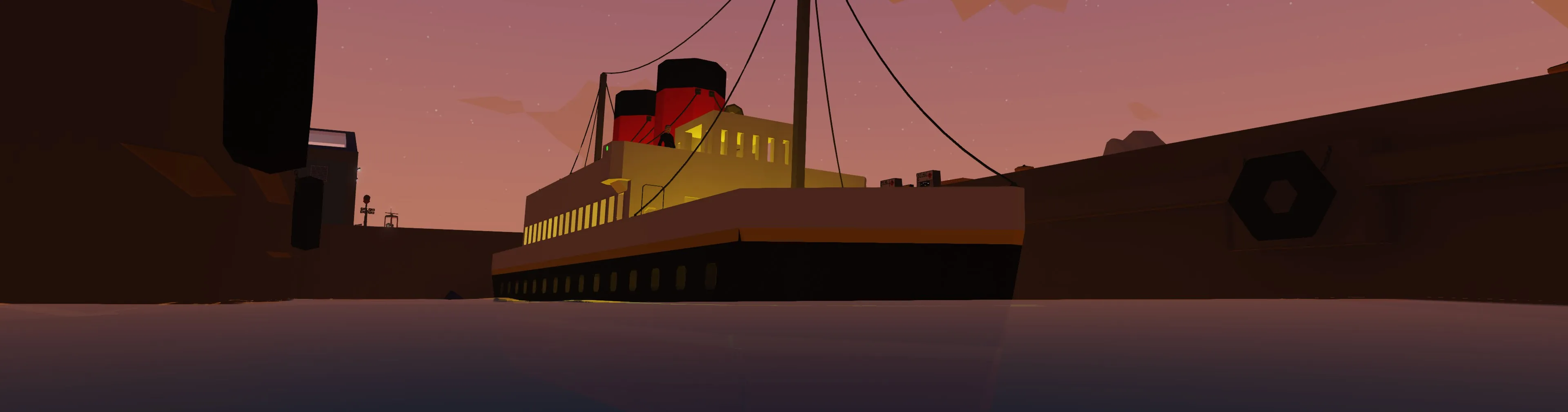
You yourself can take an enduring voyage on her through this 1:1 replica of the vessel.
Long may she lean.