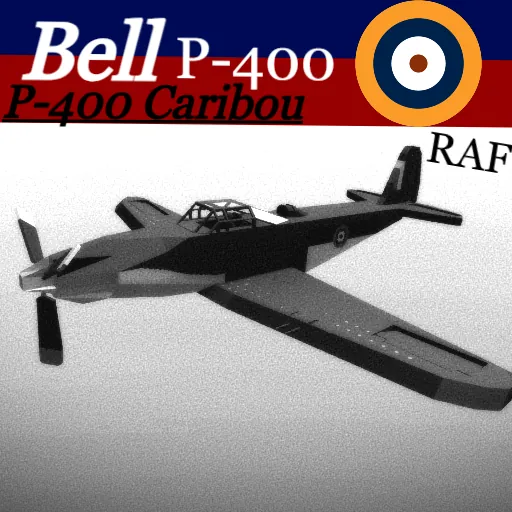
The Bell P-400 was a variant of the P-39 Airacobra, originally intended for export to the Royal Air Force before being reabsorbed into U.S. service during World War II. Designed as a single-engine fighter with a mid-engine layout and tricycle landing gear, the P-400 featured a 20mm Hispano cannon in the nose, replacing the 37mm cannon used in standard U.S. P-39 models. It also carried a mix of .30 and .50 caliber machine guns in the nose and wings. Its unique engine placement behind the pilot allowed for a streamlined nose and concentrated armament, although it complicated maintenance and limited high-altitude performance due to the lack of a turbocharger.
Initially intended to serve with the RAF, the P-400 was deemed underperforming at high altitudes and many units were redirected to the Pacific Theater, especially New Guinea and the Solomon Islands, where its low-altitude capabilities were better suited to the tactical environment. U.S. Army Air Forces pilots flew the P-400 against Japanese aircraft, and while it was often outclassed by enemy fighters at altitude, it proved effective in ground-attack roles and close air support. Despite its shortcomings, the P-400 played a valuable role in the early stages of the Pacific War, particularly during a time of limited aircraft availability.