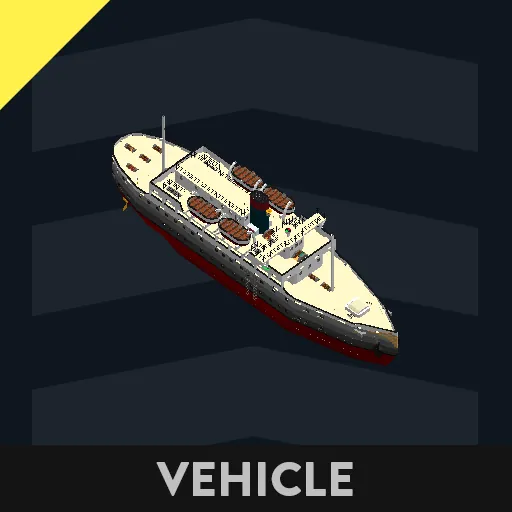
Startup:
Head to boiler room and light boiler
Head to pilot house and open steam valves
nail the throttle and your all good
Prologue:
The late 1910's had not been kind to the Royal Meier Steamship Company, its fleet of legacy ships were thoroughly obsolete, it's plans to build large replacement liners had fallen through time and again due to economic down turn and shortage of large shipyards. So in 1922 the decision was made instead of building large ships to compete with other lines ship for ship, they would instead opt to build a large number of smaller and cheaper steamers in order to undercut the market. And with that said the plan to liners 3 small liners every year for the next eight years was put in motion.
Design Characteristics for "1926 or "Sid Mead" class Liners":
Length: 47.5m
Beam: 9.25m
Draught: 4.00m
Free board: 3.50m
Speed: 14.5 Knots
Displacement: 800 tons
Crew: 33
Passenger Capacity: 38
Engine setup:
1 Gorge & Co. boiler
4 Highland Works double geared steam turbines
2 Standard Electric Works 1 ton generators
Propellers:
Sid Mead class: 2 Great Southern Shipping Co. 2.5m fixed pitch propellers
Arlbrook Subclass: 2 Great Southern Shipping Co. 2.5m variable pitch model 1925 propellers
Construction:
The third ship to be order to the "Sid Mead" design "Arlbrook" (named for the river that would ironically dry up for the last time the same year the ship launched) was laid down on the 10th of January 1926 at the Great Southern Shipping Co. shipyards in Olsen Bay. The ship differed slightly from the rest of the "Sid Mead" class liners in that it was an experiment for the variable pitch propeller. Apart from this and a slightly slower speed of 14.3 Knots there was practically no difference from the other members of its class. Arlbrook was launched on August 1st 1927 and entered service at the start of the 1928 season in march carrying its first passengers from Olsen Bay (Sawyers Republic) to Chaykovsky (Kingdom of Meier).
Nothing Special:
By all accounts Arlbrook was nothing to write home about it was just another cheep and small passenger ship in Royal Meier's fleet. Throughout the late 20's and into the early 30's the ship did its job safely and reliably with no incidents reported to authorities. However under the surface not everything was as it seemed, Arlbrook was described by former crew as torture to work on, crew conditions were cramped and central heating was only given to passenger spaces to save money, the ship was pressured to sail in any weather regardless of how bad it was the scheduled must be maintained at all costs. The ship was none to pitch and roll violently in rough weather and the ships revolutionary variable pitch propellers were prone to jamming in position in cold weather and randomly shifting pitch in rough conditions.
In 1935 Winston Porter was assigned as the ships captain and quickly proved to be both the idle company man and the boss from hell. Around passengers he had a charisma like no other and could tell a story like no other. At the same time he pushed his ship and often ignored or did the bare minimum to comply with safety drill requirements. He was by all accounts demanding, charismatic and needlessly mean to all who worked under him. The company was aware of this but due to Arlbrook under his command having met all deadlines and not been late for a single voyage he was left in place.
Through 1936 and 37 the ship gained a reputation as a lucky ship, in late May of 1937 Arlbrook was hit by a rogue wave while transiting the North Sawyers coast in a storm that rolled her 38 degrees, her vanishing angle was 40 degrees. And in June that same year the ship was left stranded for 57 hours when both the ships propellers lost hydraulic power during a storm. Many passages and crew were convinced she would capsize in the 4 meter seas, but again the ships luck came through. Upon examining the captains statements after these incidents it is clear he had an inflated opinion on both his ability and his ships sturdiness and it probably plaid into both his and the ships eventual fate.
We'll be fine:
November 21st 1938 was set to not be an ideal day. Winds of up to 40 knots were expected and seas of 4 meters. Due to this Captain Porter decided instead of heading north from Chaykovsky through the inland waterways he would take his ship south past Gustav Island and along the western edge of the Meier isles. In theory this would be safer as the northern passages out of the Sid Mead sea were known to exceptionally difficult to navigate in rough weather. At 12:30pm the ship departed and by 1:15pm Arlbrook had past Gustav Island and set its course west. Despite the poor weather forecast there was not a cloud in the sky.
Marco Wren had only joined the crew two months early when the ships old radio operator had finally had enough from captain Porter, at 2:30pm he received a new weather forecast from the coast guard reporting a new storm system moving in from the west and converging with the storm system moving in from the east. Upon delivering this report First officer Justin Barns suggested they turn around and wait out the weather. Captain Porter dismissed this stating "we'll be fine."
At 5:00 pm Arlbrook was engulfed in a snow storm with viability decreasing to 400 meters with winds of 30 knots and season of 2 meters.
By 7 pm viability had further decreased to less than 200 meters and waves were approaching 3 meters.
By now captain Porter was becoming visibly nervous he should of been able to see the Raptor Lighthouse by now and if he missed it he risked running headlong into the Malenkov Shoal 3 km north of McSteve Island. Using dead reckoning and his limited knowledge of the currents in the area captain Porter assumed he was north of McSteve Island and turned East.
7:21 pm breakers are spotted less than 100 meter in front of the ship, hard to port is ordered but its already to late.
Rocks instantly tear open the ships engine room and all power is lost. Captain Porter is in shock repeating "where are we" over and over again. 7:25 pm First officer Barns orders all passengers to the boat deck as the ship grounds hard 3 km south of McSteve Island. Due to how rough the waves are launching of lifeboats is deemed to be borderline suicidal. How ever with the ship slowly breaking apart a group of 18 crew are assembled and order into a lifeboat to go find help this included radio operator Wren. The moment the boat hit the water it was capsized throwing everyone in it into the sea. By some miracle Marco made it to shore and began wondering through the blizzard in search of help. After nearly an hour of wondering he came upon a farmhouse and was able to contact authorities, a coast guard response of nearly 300 rescuers was assembled on turtle beach but to his disbelief no rescue was attempted and the team just watched as over the next few hours Arlbrook broke apart and sank.
Aftermath:
The coast guard was heavily scrutinised for its lacklustre response after the wreck but no official inquiry into the matter was ever conducted. And the ship soon faded from memory as Royal Meier line soon commissioned a new larger ship that bearded the name Arlbrook.