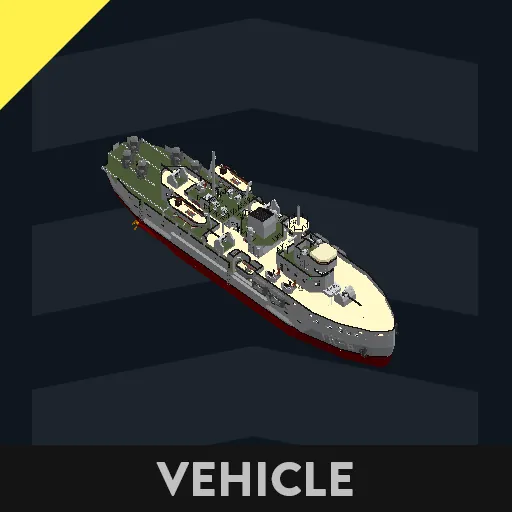
Start Up:
Head to the boiler rooms and start up all the boilers
Head to wheel house and put up the clutches
I keep it simple :p
Prologue:
By the mid 1920's the Sawyers navy found itself lacking both sea going mine layers and modern training vessels particularly in the realm of mine laying and anti aircraft gunnery. So figuring it would be cheaper to build ships that could function in both roles in early 1928 the Republican navy placed an order with the Great Southern shipping company for three ships with a displacement of roughly 500 tons, the ability to carry at least three 100mm dual purpose guns, at least 15 mines and every type of light AA gun currently in service with the navy.
Design
General Characteristics
Dimensions:
Length: 52.50m
Width: 10.75m
Draught: 3m
Propulsion:
4 George & Co. Boilers
12 Admiralty Standard Double Geared Steam Turbines
4 Standard Electrical Works 1 ton Generators
4 Great Southern Shipping Co. 2.5m fixed pitch propellers
Max Speed: 27.5 Knots
Compliment
Standard condition:
42
Training Condition:
86
Armament:
4 single 100mm Dual Purpose Guns
1 50mm AA gun
4 20mm AA guns
4 triple 8mm AA guns
22 mines
Armour:
Belt 70mm
Deck 40mm
Magazines 100mm
Gun mounts 25mm
Service Life:
1928-1944
Vindictive was laid down in August 1925 being launched in June 1927 and finally entering service in January 1928 joining the southern fleet in March conducting training cruisers in the coastal waters around the island of Donkk as well as off of Frantic Island. During this time the ship would receive a bewildering array of experimental AA guns and mines as well as MANY attempts to have the ship fitted with torpedo launchers but that was never to be. The ships were noted as being exceptionally stable in rough weather and being very good gunnery platforms overall.
During the 1930's the ships would see no less than 20 captains with the navy using the ship for officers to gain experience commanding a vessel at sea, the ship also took part in several exercises during this time, one particularly notable exercise saw the ship score simulated kills via mines on: the predreadnought Conquest, heavy cruiser Valiant, a destroyers and a fleet oilier. As you can imagine new mine sweeping techniques were adopted by fleet screening units after that one.
Civil War:
Vindictive was kept out of the Donkk uprising from October 3 1944 to June 2nd 1945 mainly due to its training duties being considered to important to risk the ship if they didn't absolutely have to. However the ship was transferred to 1st coastal squadron under Admiral Jones and moved to White Sound just in case.
On the 12th of June 1945 the ship was under the command of 45 year old Captain Henry Fame when word of a general uprising in Olsen came was received at 12:30pm. The ship was immediately deployed running several mining operations along the west Sayers coast.
On may 1st 1946 the ship got into a gunnery dual off of Point Walter 2 km west of Olsen, with frigates R-12, R-34 and J-17 which should of out gunned the mine layer but the horrifically bad sea conditions that day meant that the rebel ships couldn't use there forward guns as they spent more time under water than anything else.
In 1948 the ship was transferred to the south sawyers coastal batteries to lay minefields around frantic island as well as conduct more training missions to make up for wartime losses.
And so the ship would be in port preparing to lay mines when at 5:30am on August 5th 1948 a wave of 40 dive bombers were spotted on radar approaching the harbour, Captain Fame ordered the crew to set condition Z and fighter aircraft were scrambled from near by bases. The ship had barely worked up speed to 12 knots when the first wave began its attack. 5 aircraft dove down at the ship, Captain Fame commanding from the compass platform on top of the wheelhouse ordered hard to starboard, a single bomb hits detonating in the mess hall killing 2 men. A second group comes in 20 seconds later scoring no hits. At 5:35am another group of 5 aircraft make a run on the ship three are shot down but one lands a hit on the ships aft deck detonating the 10 mines there and destroying all of the superstructure aft of the funnel, buckling the aft deck, jamming steering and setting the aft magazine on fire. Captain Fame orders the magazine flooded but damage control centre reports the water mains have been destroyed. At 5:42 the captain orders the ship to be beached as fighters begin to strafe the ship, AA gun fire slackens as crews are killed. At 5:44 am a fighter aircraft strafes the forward superstructure killing the entire bridge crew, and hitting Captain Fame 2 times in the chest. Fame refused to leave his post ordering the one of the surviving signal men to man the helm still trying to beach his ship. At 5:48am the ships aft 100mm magazine exploded tearing the remains of the ships stern apart and she began to rapidly sink. The few crewmen still alive began jumping overboard and swimming the 600 meters to shore. Captain Fame was last seen on the main deck throwing life jackets over the side to the men in the water. At 6:10 am the ship rolled onto its side and disappeared with the bottom of its hull on being 6 meters from the surface.
Of her crew of 86 only 21 survived the sinking.
Aftermath
Immediately after the loss Captain Henry Fame was awarded the Naval Cross for his determination to save his ship and crew. The wreck was occasionally viable at low tide and was bombed several more times over the course of the war being mistaken for a submerged submarine. In 1962 the wreck was deemed a navigational hazard and was scrapped in place with only a few pieces of its stern remaining in place. One of the ships propellers as well as its Port 100mm gun mount are currently on display at the Sawyer Maritime Museum.