Overview
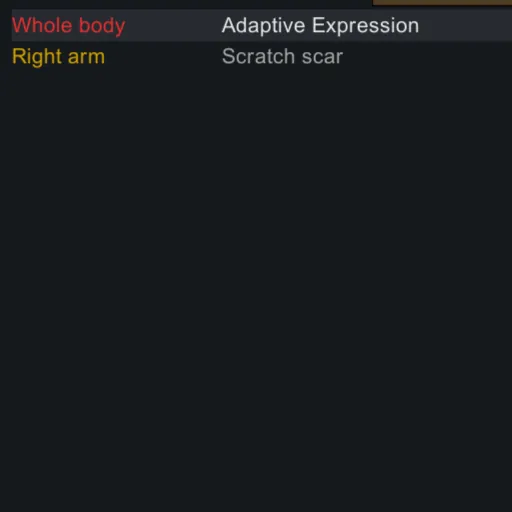
Adaptive Expression introduces a highly dynamic genetic progression system to RimWorld. Pawns with this unique gene become stronger over time especially through melee combat and physical stress. Inspired by the adaptive power scaling of Saiyans and Viltrumites, these pawns evolve as their environment challenges them.
They will not just survive; they will adapt, overcome, and eventually dominate. This mod is designed to scale with the threats in your game, whether you’re playing vanilla or running high-difficulty combat overhauls.
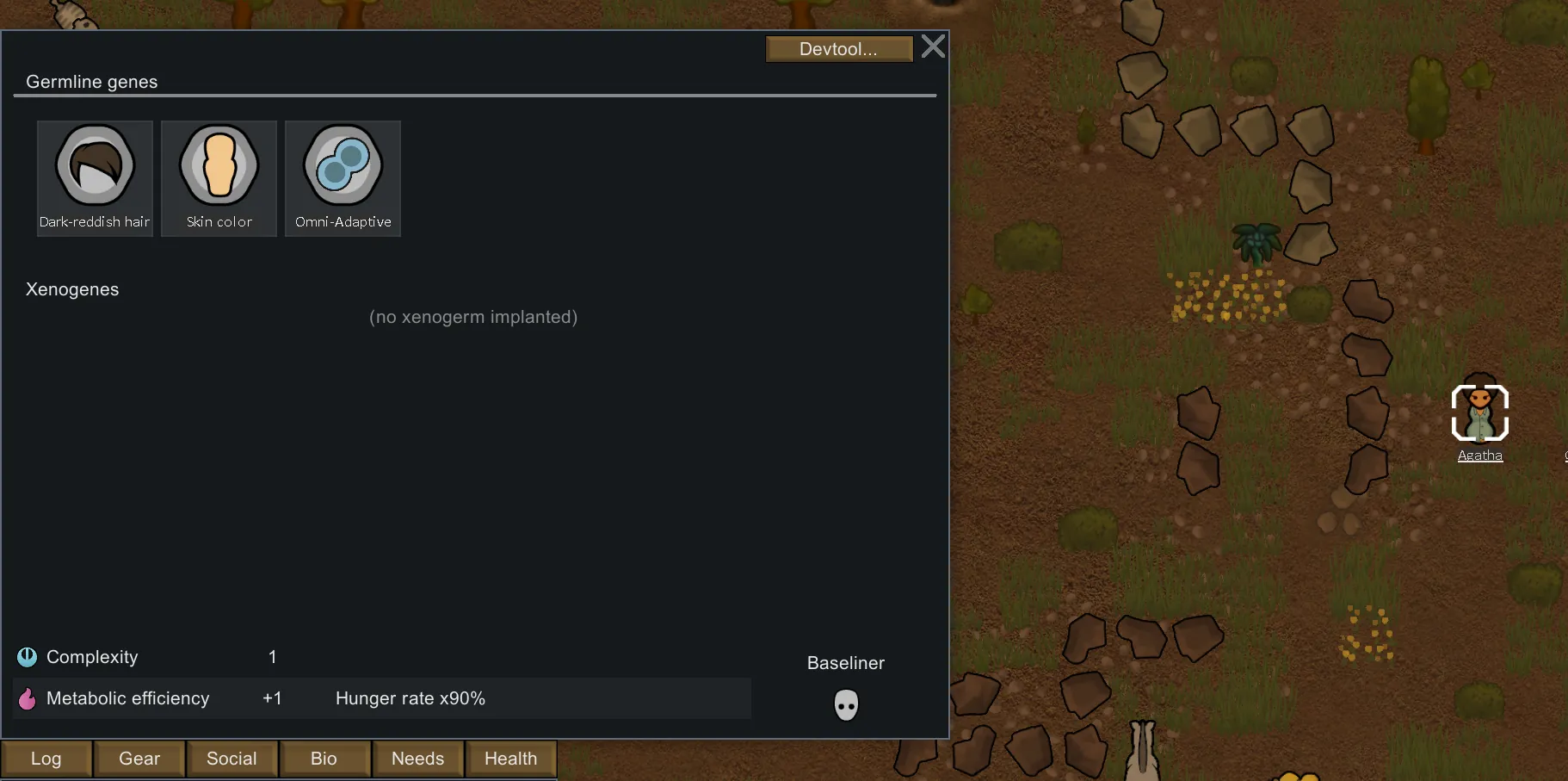
Note: (be sure to make the gene a Endogene by making the gene inheritable as the gene does not work as a xenogene)
Genetic Potential:
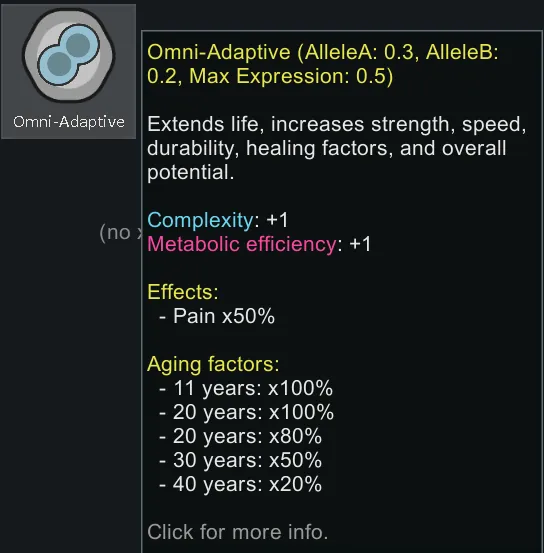
Each pawn with this gene carries two allele values, each ranging from 0.0 to 0.5. The total of both values determines the pawn’s genetic potential, which defines the maximum power level (or gene expression) the pawn can reach.
For example:
0.2 + 0.3 = 0.5 max gene expression
0.5 + 0.5 = 1.0 (hard cap)
0.0 + 0.0 = inactive gene carrier
This max potential represents the limit of what the pawn can become through progression. A pawn with low potential (e.g., 0.2) will plateau early, while a pawn with high potential (e.g., 0.8+) can grow into a powerhouse if they survive enough hardship to get there.
Progression System – How Pawns Get Stronger
1. Maturity Growth (Colony-Born Pawns)
This system is designed to support pawns born in your colony, especially those raised naturally rather than grown in vats. Over the course of 3.30 in-game years (the time it takes for a pawn to reach biological age 13), they will gain 0.1 gene expression passively, regardless of combat involvement.
This means a colony-born child will reach a baseline strength by the time they become a teenager provided they survive to that age and are raised outside a vat. This greatly improves their survivability once they enter adulthood and begin participating in combat.
After these 3.30 years, maturity-based growth stops completely. From this point on, combat progression becomes the sole method of advancement.
2. Combat Progression – The Adaptive Stress Meter
The gene includes a built-in mechanic called the Adaptive Stress Meter. It is an invisible meter that tracks a pawn's exposure to physical stress from combat. It determines when and how much gene expression growth is triggered.
How the Meter Works
The meter fills through:
Damage Taken (60% contribution)
Melee Attacks Performed (40% contribution)
Growth is only triggered when the meter reaches at least 50%.
The meter follows a logarithmic curve:
From 50% to 90%, growth value only changes moderately
From 90% to 99%, growth ramps up significantly
At 100%, a large burst of growth is immediately applied
Note: Reaching 100% on the stress meter is dangerous. A pawn will likely be near death, having taken heavy damage and been deep in melee combat. After growth is applied at 100%, the meter resets to 0, and the pawn must begin the process again.
You cannot exploit this system by spamming light melee attacks or trickling in damage. There are thresholds a certain amount of real damage must be taken, and a real number of melee actions performed, to fill the meter meaningfully.
Combat growth is deliberately slow but very noticeable. After just a few significant battles, your pawn will clearly be stronger faster, tougher, and deadlier. The more frequently your pawn fights, the faster they will evolve. Long gaps between combat will result in little to no growth.
Inherited Potential – Breeding and Genetic Logic
First-Generation Pawns (World-Generated)
Because starting pawns and world-spawned colonists typically do not have parents assigned, their alleles are randomly generated. Both values will be rolled between 0.1 and 0.5, ensuring they always have some capacity for growth.
Inheritance Mechanics
Each pawn contributes one of their two allele values, chosen at random, to their offspring. This means the child will always inherit two allele values total; one from each parent.
Gene Pairing Types:
Purebred + Purebred:
Both parents have allele values above 0.0
Child will always inherit the gene in an active state
Example:
John: 0.2 + 0.4
Jane: 0.3 + 0.5
Child: Any random combination of those four alleles (e.g., 0.4 + 0.5)
Purebred + Non-gene Parent (Hybrid):
Non-gene parent is treated as having 0.0 + 0.0 alleles
Child will inherit one allele from the gene-carrying parent, and 0.0 from the other
Example:
John: 0.2 + 0.4
Jane: 0.0 + 0.0
Child: 0.2 + 0.0 or 0.4 + 0.0
These children are hybrids, still functional, but with lower max potential
Hybrid + Hybrid:
Each parent has one non-zero allele and one 0.0
Possible outcomes:
25% Purebred (both real alleles)
50% Hybrid (one real, one zero)
25% Inactive Carrier (both zeros—gene present but non-functional)
Inactive carriers can technically produce active offspring via positive mutation, so their lineage isn’t completely lost.
Mutation System
Each allele has a 10% chance to mutate during inheritance:
5% chance for a positive mutation (+0.1)
5% chance for a negative mutation (-0.1)
These are rolled independently per allele, meaning:
Both could mutate (rare)
Only one could mutate
Neither could mutate
Inbreeding Penalty: If a pawn has the Inbred gene, both alleles are permanently reduced by 0.1, representing genetic degradation from incestuous breeding. This discourages quick-farming strong lineages without planning.
Gene Isolation – No External Enhancements Allowed
Pawns with this gene cannot receive any other genes through external means. This includes:
Genetic editing
Sanguophage gene injection
Gene packs or xenogerm use
All foreign genetic material will be rejected, and no effect will be applied. The only way to acquire additional genetic traits is through natural inheritance and breeding. This ensures power scaling is organic and earned, not artificially stacked.
Stat Scaling – What Expression Actually Affects
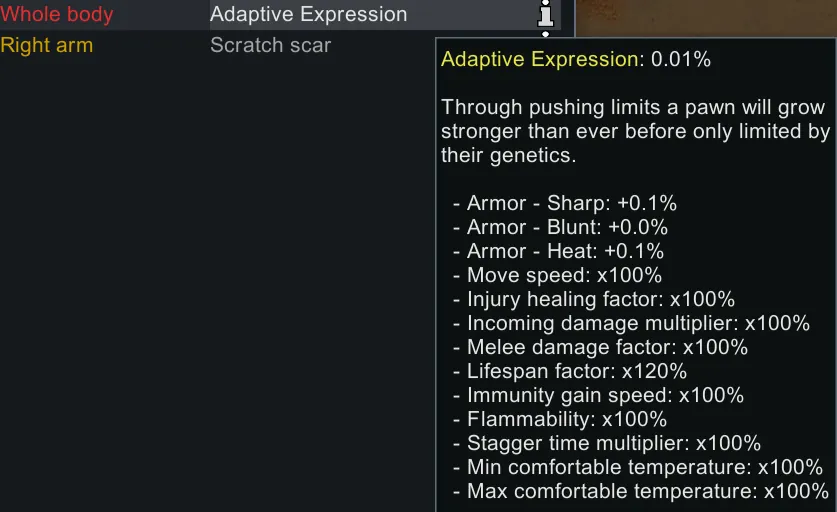
As gene expression increases, the pawn gains:
- Higher melee damage
- Greater durability and resistance
- Faster healing and no longer form scars
- Improved movement speed
- Increased armor
- Slowed biological aging (pawns often live 250+ years)
- Superior temperature tolerance
- Enhanced immunity and recovery rates
- Shorter stagger recovery time
- Lower chance of catching fire
- Vacumm resistance up to 40%
In vanilla RimWorld, the soft cap will generally land around 0.5 to 0.6, though the quality of enemies tops out pretty early, the quantity does not so you could increase difficulty through fighting more enemies in vanilla. However, with mods or DLC like Anomaly, tougher enemies may push growth further.
Restrictions for Balance
Pawns with this gene cannot:
Use or inherit Xenogenes
Possess the Tough trait or Robust gene
Use Juggernaut Serum or Metal Blood Serum
Compatibility and Support:
Compatible with most other mods
No known conflicts, but let me know if you find any issues
Fully supports modded enemies and difficulty scaling
This was a project I worked on for months because I wanted something new and immersive in terms of long-term pawn development. I had a few more features in mind but haven’t implemented them yet. If enough people like this mod and want to see more, I’m more than happy to continue updating and expanding it.
Please report bugs, share suggestions, I’m very open to refining it further based on your experience and input.
#Viltrumite #Saiyan #Strength #Evolution #CombatGene #RimWorld #Biotech #ModdedProgression #Omni-Adaptive