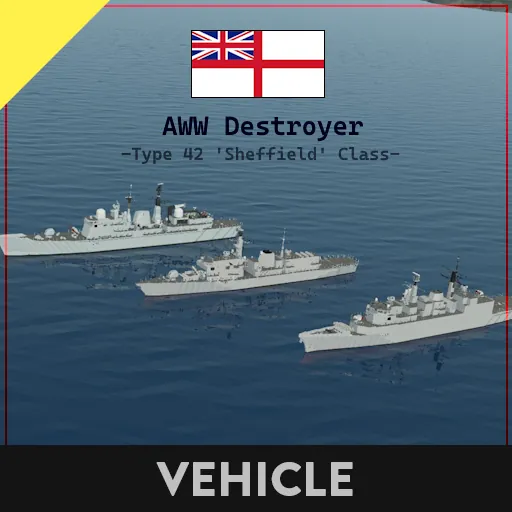
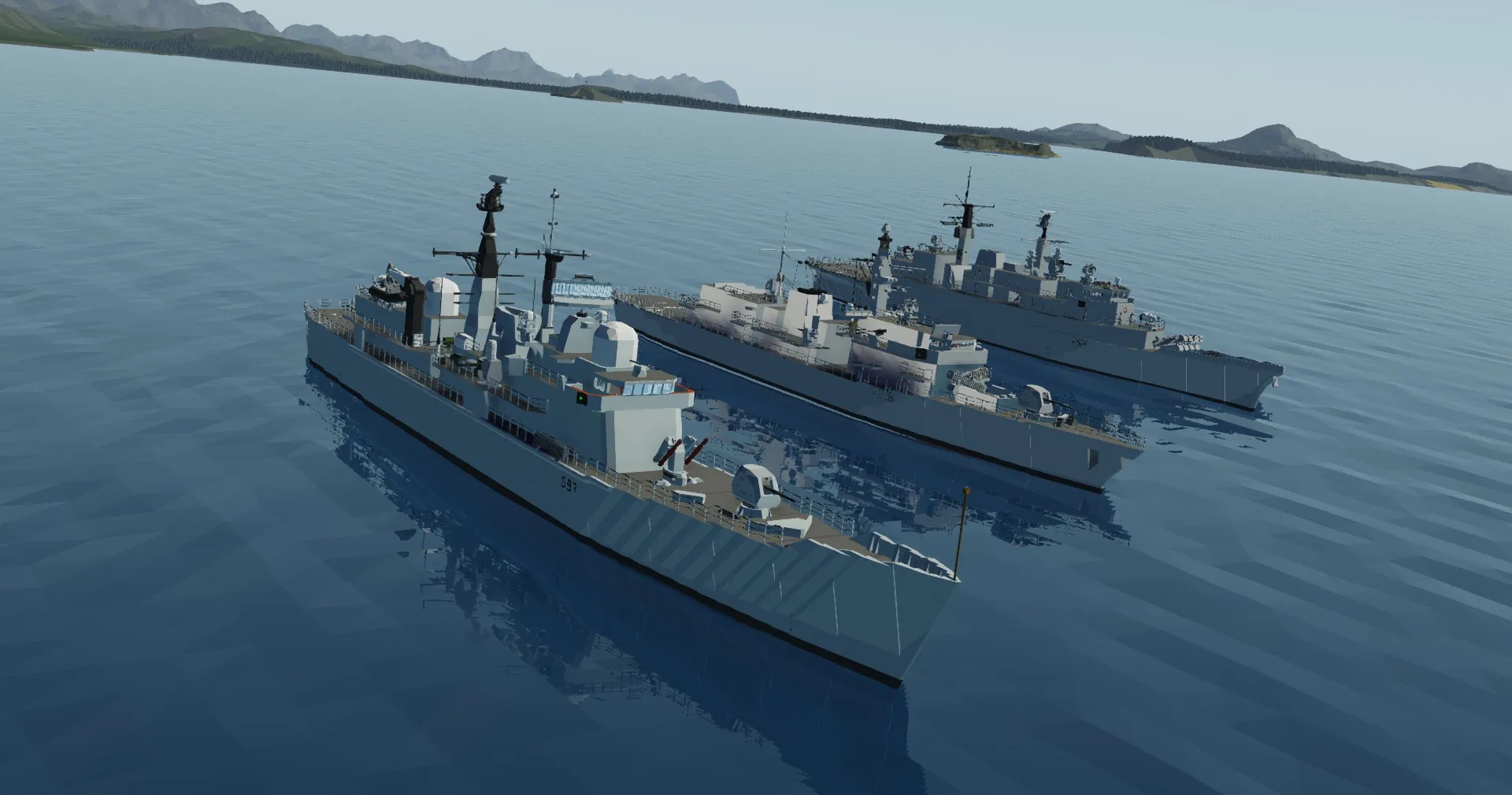
The Royal Navy's Type 42 Destroyer (Sheffield Class)
Overview
The Type 42 Destroyer, also known as the Sheffield-class, was a class of guided-missile destroyers that served as the backbone of the Royal Navy's air defense from the mid-1970s to the early 2010s. Developed in the late 1960s as a more affordable and compact alternative to the cancelled Type 82 destroyer, the Type 42 was designed primarily for fleet air defense against high-flying aircraft and missiles. A total of fourteen ships were built across three batches, with two more constructed for the Argentine Navy. The class is most famously remembered for its service during the 1982 Falklands War, where it both demonstrated the effectiveness of its main weapon system and exposed the vulnerabilities of its design.
Design and Specifications
The Type 42 was a much more austere and compact warship than its predecessors, a direct result of budget constraints. The initial batch of ships had a length of 125 meters and a displacement of around 4,800 tonnes, which unfortunately led to poor seakeeping in heavy weather. Later batches (Batch 2 and Batch 3) were lengthened to improve their performance at sea.
Propulsion: The ships were powered by a Combined Gas or Gas (COGOG) propulsion system, using Rolls-Royce Olympus gas turbines for high-speed operation and Rolls-Royce Tyne gas turbines for cruising. This arrangement allowed for speeds in excess of 30 knots and a range of approximately 4,200 nautical miles. The COGOG system was pioneering for its time, providing a flexible and responsive power plant.
Complement: The ships typically carried a crew of around 270 personnel.
Weapons and Sensors
The Type 42 was built around a single, powerful air defense system, reflecting its specialized role.
Main Weapon System: The primary armament was the GWS-30 Sea Dart surface-to-air missile system, housed in a twin-arm launcher at the bow. This medium-range system was designed to engage high-speed, high-altitude air targets, and while it had limitations against low-flying aircraft, its presence was a significant deterrent.
Guns: For surface engagements and shore bombardment, the destroyers were equipped with a single 4.5-inch (114mm) Mark 8 naval gun. In its early service, the ships' close-in defense was notably lacking, consisting only of manually-aimed 20mm cannons. However, after the Falklands War, surviving ships were retrofitted with modern Phalanx Close-In Weapon Systems (CIWS) to provide a last-ditch defense against incoming missiles.
Aviation: A key feature of the design was the inclusion of a flight deck and hangar, which allowed the ship to operate a Lynx helicopter. This provided a crucial anti-submarine warfare (ASW) capability, as well as a platform for reconnaissance and surface attack with Sea Skua missiles.