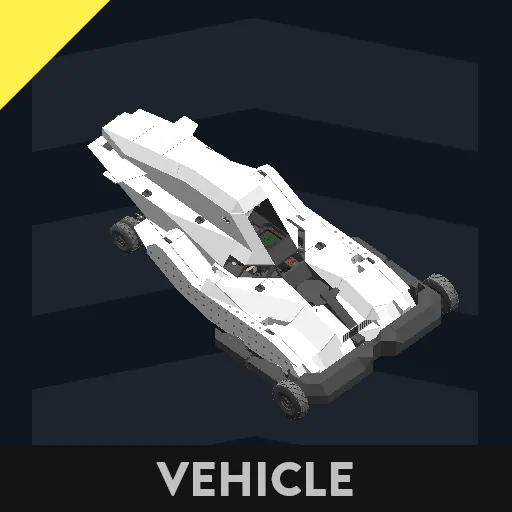
The car serves as a basic ground vehicle that humans use to travel over land. It carries individuals, along with some light loads of cargo. This device usually features four round traction elements known as "wheels" crafted from treated natural materials such as organic polymer, but synethetics are often utilized in the modern world. Those are known as rubber tires. They attach to a sturdy metal frame.
Power comes from either a combustion engine or electric motors. The combustion type turns fuel from processed hydrocarbon remains into mechanical motion. It does this by expanding hot gases. The electric version runs on batteries that recharge. Most often those are lithium-ion cells. Energy stays stored right inside the vehicle. It drives the wheels through a mechanical system of gears or an electrical transmission system. In our test version we swapped in a small jet engine instead. This lets us examine intense push forces in the air. We can also check how much stress the structure handles at faster paces.
One person operates it from inside a tough shell made of metal and plastic. That is the cabin. They control speed and turns with hands and feet. There is a round steering wheel for direction. Pedals apply pressure for go or stop. Clear glass windows give views outside.
Speeds normally hit between 13 and 33 meters per second. These machines help a lot in daily life. Still they add heavily to carbon dioxide in the air. They also waste space in cities. Even so humans feel deeply connected to cars on an emotional level. Culturally they see them as signs of success. Cars become part of who they are in a way.
Human vehicles incorporate a range of passive and active safety systems designed to reduce injury and mechanical damage during high-velocity incidents. As mentioned before, a tough shell made of metal and plastic named a "safety cell" is engineered to maintain integrity, even if the vehicle was involved in an impact. Zones that are often involved in impacts are titled "crumple zones," and are intended to absorb the kinetic energy that would otherwise be transferred to the vehicle's inhabitants, proving potentially lethal.
Vehicle occupants are often restrained by fabric harnesses known as "seat belts," which limit forward motion during rapid deceleration. The operation of seat belts is fundamentally governed by Newton’s First Law of Motion, which states that an object in motion will remain in motion at a constant velocity unless acted upon by an external force. However, rather than stopping the body instantaneously, which would produce catastrophic force levels, the seat belt allows for a slightly extended deceleration time interval. By increasing the time over which the occupant’s velocity is reduced, the seat belt effectively decreases the magnitude of the decelerating force experienced by the body, as described by the Second Law (F = Δp / Δt, where Δp is the change in momentum and Δt is the time over which it occurs). In essence, the seat belt functions as a controlled energy absorber, similar to the intertial dampeners found on most of our spacecraft.
Modern cars put active safety features to work in preventing crashes. They include things like traction control and stability systems. Automated braking helps too. Multi-sensor networks round out the setup. These rely on tech such as RADAR for detecting objects. RADAR sends radio waves out. It measures the reflections to gauge distance and speed of nearby items. Ultrasonic sensors follow a similar approach. They use high-frequency sound waves for detecting things up close.
Vehicles pull data together from radar units, cameras, and ultrasonic detectors. This lets them spot obstacles in the way. They can track lane position as well. Speed adjustments happen automatically when needed. Such systems allow for some semi-autonomous driving. They support human drivers in dodging collisions. This proves especially useful in low visibility or when quick reactions matter.
Even with those steps in place, safety features still rely a lot on how humans pay attention, their reaction speeds, and whether they keep up with maintenance. Those factors stay as major risks in everyday ground travel. On top of that, certain people choose to overlook or shut down these safety tools on purpose. Things like skipping seat belts or bypassing automatic controls just make accidents more probable and a lot more serious.